Bible Study for Texas for 9_21_82503

Posted: 8/22/03

Baptistway Lesson for Sept. 21

Philippians 2:19-30

Make a difference with your life

By David Morgan

Our pre-teens attended camp this past summer at Highland Lakes Conference Center. They had a marvelous week. Marcy, an elementary school teacher, and Mary, a college student, went as sponsors. They, like the students, returned with glowing reports of their camp experience. I was grateful for their willingness to attend and to prepare in advance for the Bible studies and church times. God made a difference in the lives of our children because Marcy and Mary made themselves available.

Our youth attended camp the same week at Pineywoods Baptist Encampment. Curtis planned to go as a sponsor, but at the last minute work schedules left the teens without a driver. Mickie stepped in and drove a van to the camp and returned home the same day. On Thursday, Howard took a day off from work so he could bring the youth home. Five of our students made professions of faith during the week. God made a difference in the lives of our students because Mickie and Howard made themselves available.

People who make a difference in the lives of others give of themselves in serving others for Christ's sake. Philippians provides us with two examples of men who gave themselves to Christ and to his work.

Paul's plans for Timothy

Paul's imprisonment prevented him from personally visiting the Philippians. This created two problems for the apostle. First, he could not receive first-hand information about their condition but had to rely on reports from others. Quite likely, Epaphroditus had been gone so long from Philippi that the information he relayed to Paul was out-of-date. The second issue was that Paul could not share information about his current condition with his friends. He wanted to quiet the fears of the Philippians; tell them he was doing well.

Paul planned to send Timothy to Philippi as soon as possible. Timothy had ministered to the Philippian church with Paul on several occasions (Acts 16:1,3; 19:22; 20:3-6). Timothy had earned Paul's confidence through his years of joint service. Paul had dispatched him on many crucial assignments (Acts 17:14-15; 18:5; 19:22; 20:4; 1 Corinthians 4:17; 16:10, 1 Thessalonians 3:2, 6).

Paul intended for his young colleague to visit Philippi to report on Paul's situation and return with an update on the church. Paul trusted Timothy would return with an accurate and positive report that would cheer Paul's spirits. Since the letter of Philippians would have been sent earlier, I suspect Paul wanted to hear if the church had eliminated factions and restored broken relationships in the congregation.

Paul's letters and Acts reveal he was not alone in Rome. But Timothy alone, of all Paul's possible choices as a representative, possessed a kindred spirit with Paul. Years spent together had forged Timothy into a man Paul could trust. Timothy would have the best interests and welfare of the Philippians in mind.

Others whom Paul could have sent might have had divided loyalties. They might have brought a report clouded with information that served their personal advantage. Their message might have been tainted by selfish ambition. Paul had mentioned in the first chapter that some were preaching the gospel out of envy and strife. They were more concerned with personal gain than with what Christ Jesus would have desired for the church.

Paul elaborated further on his relationship with Timothy. He had served with Paul as a child would serve his father. Paul called Timothy his son in the faith (1 Timothy 1:2). This designation and Timothy's joining of Paul and Silas on their first missionary journey suggests Timothy was converted during Paul and Barnabas' missionary journey. Paul had nurtured Timothy and watched as the young man was tested by adversity. Through it all he had remained true to Christ and to Paul.

Communication capabilities have advanced dramatically since Paul wrote Philippians. When this material was finished. it was transmitted electronically to the Baptist Standard. It usually transfers almost instantly with no glitches. It was a direct delivery of information between the editor and me.

The sharing of information was far less reliable and much slower in ancient times. Information was carried by letter or messenger, both of which often took extensive time. Regular postal service did not exist, and correspondence was carried by individuals. We can easily see the need for trustworthy messengers and couriers. Timothy fulfilled a most significant role in the communication between Paul and the Philippians. We should not underestimate his importance and the role he played.

When Paul sent the letter to the Philippians, he was anticipating some resolution of his current situation. He wanted to know the results of this before sending Timothy. He wanted the information to be as accurate and up-to-date as possible. Paul still felt certain he himself would soon be able to visit the Philippians.

Plans for Epaphroditus

Paul apparently sent this letter with Epaphroditus. That Paul would state he felt it necessary to send Epaphroditus back may sound odd. Epaphroditus had brought the Philippians' gift to Paul. The Philippians had placed a great deal of confidence in Epaphroditus, entrusting him with the gift and with the facts about their situation. He likely had planned to remain in Rome with Paul and assist him in any way he could.

Paul's referring to him as “my brother,” “fellow worker” and “fellow soldier” suggests he planned to stay and serve with Paul for an extended time. As brothers in Christ, they shared a relationship through their Lord. As fellow workers, they labored together. They shared common dangers as soldiers of the Lord.

Epaphroditus had fallen gravely ill while in Rome. The Philippians had received a report of his illness and were quite concerned about his welfare. Paul reported that God intervened during his sickness and restored him to health. Paul described God's intervention as an act of divine mercy. God bestowed this mercy first on Epaphroditus in sparing his life but also on Paul, for Epaphroditus had served him well. Furthermore, Paul noted that Epaphroditus had developed a severe case of homesickness and wanted to return to Philippi.

Paul sent Epaphroditus back to allay the fears of the Philippians. Their concern about their fellow worker created some anxiety for Paul. Their uneasiness affected his well-being. Paul would have a greater peace if he knew the Philippians were not worried about their co-worker.

Paul instructed the church to receive Epaphroditus with joy. Servants like him deserve to be revered by the church. They provide an example for other Christians as the minister to others for Christ. We know nothing about this man apart from what Paul wrote. God is able to use the unsung hero to achieve great things. This obscure man nearly died in serving God. He shouldered the responsibility for the Philippian's service to Paul. Distance prevented them from fully ministering to Paul. Epaphroditus was able to complete their service and attention to Paul through his personal ministry.

Gerda is one of those unsung heroes who reflect the qualities of Timothy and Epaphroditus. Several months ago, our deacons honored her with a “hug 'em and mug 'em” coffee cup. Gerda ministers to our homebound. She has never been formally elected to this task. She simply began to visit them. She asked our sound technicians to provide a tape of our services to carry to the homebound. When it became impractical for her to copy tapes, she challenged us to purchase a tape duplicator. She reports often how blessed our homebound are by this simple ministry. One person like Gerda who serves can make a difference. What service can you offer? How much better to obey willingly than by compulsion!

Questions for discussion

bluebull What qualities do you look for in a person who represents you before others? What can you do to develop these qualities in yourself?

bluebull Imagine a gathering at church for prayer in which those present offer only reports of what God is doing in

their lives. Compare or contrast that with what occurs now when prayer concerns are shared.

bluebull In what ways do church members put their own interests above those of the church?

bluebull What is our responsibility to those whom we select as ministers/servants for our churches? (Include Sunday School workers, deacons, committee or team leaders in addition to church staff.)

bluebull What risks are you willing to take to serve Christ? What risks do you consider too great to take?

News of religion, faith, missions, Bible study and Christian ministry among Texas Baptist churches, in the BGCT, the Southern Baptist Convention ( SBC ) and around the world.


Bible Study for Texas for 9_28_82503

Posted: 8/22/03

Baptistway Lesson for Sept. 28

Philippians 3:2-14

Keep focused on knowing Christ

By David Morgan

Texas native Lance Armstrong won his fifth straight Tour de France last July. He appeared the morning after his victory at a press conference titled: “Life After Cancer: A Celebration Of Life.”

Armstrong is not only the pre-eminent cyclist in the world but also a cancer survivor. Armstrong said at the conference: “It's an honor to win the Tour de France but even more so as a cancer survivor. When I think about a crash on Luz Ardiden or a cyclocross in Gap, and then think back to 1996 and being in a hospital bed in Indianapolis, it's easy to choose.” Armstrong has kept cycling in proper perspective.

Paul's word to the Philippians can help us to keep our lives in proper perspective. An appropriate outlook on life includes a lifelong quest to know Christ fully.

Watch out for false teachers

False teachers threatened the Philippians' well-being. The attack came from a faction of Paul's opponents known as Judaizers. This party was comprised of men who believed that Gentile Christians had to submit to and practice certain Jewish rites before they could become Christians. Paul relentlessly battled this heresy, which may have been dividing the Philippian church.

Paul warned the church to resist this group, which he likened to dogs. Now Paul was not thinking of the domesticated dogs many of us have as pets. Dogs in his day were ferocious scavengers. They roamed the streets and were known to viciously attack people. Both Jews and Gentile used this term to express contempt toward the other. Paul used the word as one of rebuke.

He warned the Philippians to stay clear of these teachers. He further referred to them as evil workers. They felt that they were acting in righteous ways, but Paul saw their acts were evil. He urged the Philippians to realize that the Judaizers taught a false circumcision. The word Paul used for circumcision was used in the Old Testament for mutilations and other incisions which were prohibited by the law (Leviticus 21:5; Deuteronomy 14:1). Paul's strong language stressed the severity of the threat.

Boast in Christ Jesus

True circumcision was not a physical act. It was the church's recognition that the body of Christ comprised the new people of God. Paul wrote in Romans that true circumcision was of the heart and not the flesh (Romans 2:25-29). He spoke in similar words to the Corinthians: “Circumcision is nothing, and uncircumcision is nothing, but what matters is the keeping of the commandments of God” (1 Corinthians 7:19). Paul's word for worship described the worship of God's special people, those who worship him in Spirit and truth.

Those who are of the true circumcision boast in what Christ is doing and not what they think they are accomplishing. Christ alone was the subject of their praise and adoration. The Christians had no reason to trust in or to brag about anything in their lives was apart from God and outside of what Christ was doing.

The futility of the past

If any person had reason to trust his birthright and past accomplishments to please God, it was Paul. Whatever others might submit as reasons for boasting, Paul could exceed them. He listed those things in his life that some would consider advantages in knowing Christ (verses 5-6).

Paul was circumcised when he was eight days old. His parents followed the law closely in this regard (Genesis 17:12). Abraham circumcised Isaac on the eighth day (Acts 7:8). Jesus and Mary did likewise for Jesus (Luke 1:59). That Paul was circumcised as an infant also proved he was a Jew from birth and not a convert. His parents must have been devout Jews to perform this act so diligently.

Paul's adding he was “of the nation of Israel” further showed that he was not a Jewish proselyte but was a Jew by birth and ancestry. Paul could not only claim a Jewish genealogy, but he could trace it back to the tribe of Benjamin. This small, faithful tribe remained loyal to the Davidic dynasty when the kingdoms divided after the death of Solomon. Israel's first king, Saul's (Paul's Hebrew name) namesake, came from Benjamin.

Paul was a “Hebrew of Hebrews.” Many Jews in his day had adopted a cosmopolitan attitude toward the world. They spoke Greek more fluently than their native tongues of Hebrew and Aramaic. But Paul came from Hebrew parents who preserved a Hebrew heritage. Paul was faithful to the ancient Jewish culture in all ways.

The Pharisees counted Paul among their number. Faithful and strict adherence to the law was one mark of this religious sect. This conservative and influential group of laymen sought to preserve the religious heritage of Judaism.

Paul was more than simply a member of the Pharisees. His leadership was evident when he watched over the cloaks of those who stoned Stephen (Acts 7:58). He demonstrated his enthusiasm when he began to attack Christians. The apostle was traveling to Damascus to pursue and persecute Christians when Christ appeared to him in a blinding light.

Paul declared he was blameless in the law. He scrupulously kept the commandments. No Jew could find any fault in Paul. He stood at the top of his class.

Abandoning all for Christ

Paul had catalogued a rather comprehensive list of qualities that would have given him reason to boast in the flesh. “In the flesh” means apart from God and not necessarily carnal. Paul consciously and willfully rejected at his conversion the previously mentioned list of traits. Paul had considered life without Christ and the benefits of his Jewish heritage. He contrasted those with what Christ offered. He chose Christ and rejected the advantages of his past.

Verse 7 deals with Paul's past conversion (“I have counted”). In verse 8, Paul was describing his current state and attitude (“I count”). Paul's earlier list of advantages focused on religious matters. He now made clear he would count “all things” as loss for the sake of his new relationship with Christ. He would cling to nothing which prevented him from knowing Christ intimately. By referring to Christ as Lord, Paul admitted Christ held an absolute and ultimate claim on him. Paul had relinquished control of his own life for the sake of serving the Lord Jesus Christ. All those things which Paul had prized earlier in his life he believed now to be rubbish.

To be found in Christ

Paul's aim was to gain Christ, that is to more and more allow the Lord to control him. Paul also wished he would possess more and more of Christ in his life. “To gain” considered Paul's present situation. “To be found” in him looks to the future. Paul wanted Christ to find him a faithful member of the body of Christ when the Lord returned or at the apostle's death. Being found in Christ included a righteousness only God could bring. Paul had rejected all of his heritage and adherence to the law as a means for achieving this right standing before God. He had discovered only God could impart to him a righteous, upright quality of life. Paul appropriated this righteousness through his personal trust in Christ.

To gain Christ and to be found in him would produce an intimate relationship with Christ. Paul wanted to know Christ better. Paul wanted to experience the power of the resurrection in his own life as God further transformed him in mind and spirit. He connected experiencing the power of the resurrection to the fellowship of his sufferings. Paul felt that to experience suffering because he was proclaiming the gospel would deepen his faith. He did not flee from suffering but embraced it as a medium of God's grace.

He believed that as he died more completely to self he would be raised to the life Christ planned for him. Paul anticipated that at life's end he would experience the fullness of being redeemed through Christ's resurrection.

Pressing on toward the goal

Paul figuratively, and perhaps literally, took a breath after plumbing the depths of his desire to experience all Christ had to offer him. He acknowledged that what he had been contemplating would only be fully realized in the future. His conversion on the Damascus road was only the first step on the journey. He remained a pilgrim on earth, seeking the perfection in Christ that could only come when the journey had ended. But he continued to strive for what he still lacked. Christ took control of Paul's life near Damascus. Now Paul prayed he might know Christ and everything this new relationship entailed. Christ had a plan for Paul. Paul sought to know it and accomplish it.

Paul made no pretense in claiming he had attained all Christ had prepared for him. Paul had spent countless hours in prison contemplating what Christ was doing in his life. His statement was not one of false humility. He genuinely knew he had far to travel in his walk with Christ.

Paul was so overcome with emotion he omitted the verb “do” and literally said, “one thing.” That “one thing” was to forget the past and reach for the future. Obviously Paul could not erase his memories, but he could live in such a way that he refused to let his past control and determine his tomorrows. He described himself as straining forward toward the future and the prize which Christ held for him.

Paul had renounced his past. He rejoiced in his present circumstances, and he fixed his gaze upon Christ's goal for him. “Goal” translates a word found only here in the New Testament and usually means a mark for shooting at. The prize that awaited him had been determined by Christ.

I've heard it said that who you know is more important than who you are when it comes to getting a job. I have doubted this statement, although it sometimes appears to be based in fact. But when it comes to the Christian walk, who you know is all that counts. Who you are has been replace by the new creature you are in Christ. Keep focused on Christ. The best way to live your life is to seek constantly to know Christ more fully and completely.

Questions for discussion

bluebull Name some false teachings Christians may hear taught in their churches.

bluebull If we can never achieve perfection, why should we keep trying?

News of religion, faith, missions, Bible study and Christian ministry among Texas Baptist churches, in the BGCT, the Southern Baptist Convention ( SBC ) and around the world.


Bible Study for Texas for 9_7_82503

Posted: 8/22/03

Baptistway Lessons for Sept. 7

Philippians 1:1-26

Look at life positively

By David Morgan

My family and I met Georgia when she visited the church I served as pastor. She and her husband, Willard, became dear friends. They filled in as surrogate grandparents for our daughter at school functions. We came to love them deeply.

Georgia and Willard's positive approach to life impressed me from the moment we met. They simply loved life. I later understood that the basis for their attitude was their deep faith in Jesus Christ.

While many of us can maintain a positive posture during good times, Georgia retained hers through several years of battling the cancer which ultimately took her life. Her upbeat spirit embodied the positive look at life which Paul possessed and described in Philippians 1.

Life can be tough. Some people celebrate life amid its struggles, while others are shrouded by clouds of gloom and despair. A maturing and growing relationship with Christ, good relationships with other Christians and a confidence in God's future can foster a positive approach to life.

A foundation for positive living

Paul's opening words offer insight into why he looked at life positively. God had called Paul to be one of the Lord's chosen servants. God had transformed Paul from one who had been enslaved to sin to one who spent the remainder of his life as God's slave. Paul possessed in his life the grace and peace he desired for the Philippians.

The Philippians had tasted God's grace. Paul reminded them that as saints God had set them apart for service. God had taken the initiative in calling them, and they had responded affirmatively to that call. It takes both divine initiative and human response for one to become a Christian. In no way does “saint” suggest a super-Christian or a religious fanatic. All Christians are saints because God has redeemed them and given them new lives in a new community.

Paul expressed his wish that the Philippians receive continued grace and mercy from God. “Grace” is God's free and unmerited love and favor toward those who do not deserve it. God's grace makes possible salvation with its new relationship to God.

Flowing from God's grace is God's peace. “Peace” describes the believer's reconciliation to God, self and others. It is more than an absence of strife. It is a spiritual contentment in the midst of turmoil.

Grace and peace come from God the Father and God the Son.

Christian relationships nourish positive living

Paul's warm relationship with the Philippian church nourished his positive outlook. Paul jumped into the body of his letter with an earnest thanksgiving for the Philippians.

Paul's feelings for this church seem to have run deeper than for any other congregation. He established it during his second missionary journey (Acts 16:6-40). Paul received a vision of a Macedonian man bidding him to come and proclaim the gospel in Macedonia. Paul and his companions accepted the invitation and journeyed to Philippi. There they met a group of women who had gathered on the riverbank outside the city to worship. Lydia and her family were converted. When Paul and Silas freed a slave girl of a demonic spirit, her master filed charges and had them imprisoned. Paul displayed his positive approach to life when he and Silas were singing during the night they spent in the dungeon.

When God opened the bars to the jail and the jailer threatened to kill himself, Paul quickly reassured him no prisoner had fled. The jailer professed faith in Christ, took Paul and Silas to his home, and treated their wounds. The authorities released Paul and Silas the next day, and Paul left the city. But the foundation of a deep and abiding concern between the Philippians and Paul had been poured.

Paul offered this prayer of thanksgiving while a prisoner in Rome. Ephaphroditus had brought the apostle a gift from the Macedonian church (Philippians 2:15; 4:18). Paul's thank-you note gift allowed him to reminisce about their history together. He recalled his fondness for them and assured them of his habitual prayer for them. He joyously thanked God that they continued to show concern for him and to participate in his work.

The church first supported Paul financially when he went to Thessalonica from Philippi (Philippians 4:16). He prayed for God to continue to bless them. The apostle described their sharing with him as actually making them participants in the spread of the gospel. They were more than bystanders.

Paul voiced his certainty that God would complete in their life the work the apostle had started years earlier. He expressed confidence both in the Philippians and in God's faithfulness. Paul trusted God to guide them to experience all aspects of salvation. God would empower and enable them to complete their Christian pilgrimage until Christ returned.

The Philippians' support of Paul demonstrated they were developing as believers. Paul was pleased with this growth. Despite his chains and accompanying humiliation, the church remained committed to him. Memories of them encouraged him in this time of imprisonment.

Note that Paul referred to his imprisonment not as an ordeal but an expression of God's grace. Still, Paul was “homesick” for his friends. He loved them with the love Christ had planted in him.

Praying for continued spiritual development

Having expressed gratitude for them and confidence that God's grace continued to work in their lives, Paul prayed they might increase in love, knowledge and discernment. He knew of their unfailing love for him and for others. He prayed this love would gush forth in a search for sound judgment and proper moral discernment.

They needed a spiritual perception that would enable them to distinguish those things that were pure and spotless. By knowing those things that were excellent, they could live blameless lives, filled with God's righteousness. A blameless life includes not causing other Christians to stumble in their growth.

Paul knew Christ had filled them with fruit of righteousness. God had declared the Philippians righteous when they trusted Jesus as Savior. Paul desired that the Philippians not only be declared righteous, but that they give evidence of this righteousness. God declares us righteous and then makes us righteous in action.

Paul fully expected that God would answer his prayer. As the Lord answered it, God would receive praise and honor because of the lives of the Philippian Christians.

Confidence despite imprisonment

That Paul could express a positive outlook because of what God was doing in the life of the Philippians seems obvious. That he could express one in his own situation is shocking. Paul had been imprisoned for more than two years and was facing a trial before Nero. While some people would moan over such circumstances, Paul rejoiced because God was using them to spread the gospel.

Paul had committed no crime for which he deserved jail time. He had been confined solely because he proclaimed the gospel. Paul had angered a group called the Judaizers. These men insisted a Gentile must become a Jew before becoming a Christian. Paul rejected this dogma outright. The Judaizers hounded Paul in his travels. While in Jerusalem at the end of his third journey, the Jewish authorities charged him with taking a Gentile into the temple with him. The Romans then arrested him for disturbing the peace, because Paul's Jewish opponents had incited a riot. The Romans took Paul to Caesarea after Paul's nephew informed him a band of Jews had plotted to assassinate him in Jerusalem. When Paul faced the possibility of returning to Jerusalem for trial, he appealed to Caesar.

The Praetorian guard, elite Roman soldiers who guarded him in Rome, realized he was imprisoned only because he preached the gospel.

Paul rejoiced that his imprisonment had advanced the gospel. Paul was blazing a trail for Christians to follow in his suffering. He could understand why the Philippians might not understand his attitude, so he explained it. Paul's example emboldened some Christians in Rome. If he could endure such hardship, they could preach without fear. On the other hand, self-seeking Christians preached with the intent to discredit Paul. Paul was not upset but was thrilled the gospel was being proclaimed, whatever the motive behind the proclamation.

Paul believed the proclamation of the gospel would vindicate him. While he apparently did not feel the preaching would lead to his quick release, he confidently asserted the preaching would authenticate his stand for Christ. Suffering and proclamation in Paul's case were intertwined.

Imprisonment for the sake of Christ would only strengthen and deepen Paul's relationship to Jesus Christ. His circumstances would propel him toward a fullness of his salvation experience.

Paul attributed his vindication to two things: (1) the prayers of the Philippians and (2) the provision of the Holy Spirit. Paul had repeatedly mentioned the Philippians' participation with him in his imprisonment and ministry. The Spirit would undergird and strengthen Paul with all the help he needed, both in his current and future situations.

Let's not forget that Paul was in prison. Although it appears that he was in a rented house chained to a guard and not in a dungeon, he was still confined. While many of us would be preoccupied with being released, Paul's primary concern was not freedom but glorifying Christ. He wanted to do nothing that would shame his Savior. He expressed the hope that he would remain courageous whatever happened to him.

Verse 21 finds Paul uncertain about his future. He had done nothing to warrant a death sentence, but with Nero as emperor, he could not be certain about his fate. His language suggests he was immersed in a great internal struggle. Should he live, Christ would continue to be his Lord.

However, he considered death better, for he would receive his heavenly reward and be forever in the presence of Christ.

As Paul further reflected on his future, he knew that living would be good, for he could continue his work as Christ's servant. Broken sentences again stress Paul's internal wrestling. My dad might translate Paul by saying that he was between a rock and a hard place. He wanted to cut loose the ropes of the ship of life and be with Christ, but to continue to dwell on earth would be “much, more, better” for the Philippians.

Paul's struggle appears to have ended with verse 25. God had revealed to him in some way that he would not be executed. We have no way of knowing if he received a direct revelation from God, favorable news or simply a further reflection on his situation. He would remain with the Philippians so they might rejoice in his deliverance and increase their joy in Christ when he visited Philippi after his release.

Lessons for life

Sooner or later, all of us face difficult times. We cannot escape them. How we address these times depends to a large measure on the support we have from the community of faith. We can cultivate that relationship by praying, thanking God for other Christians. Pray regularly for them.

Knowing that God uses suffering to further his kingdom work provides a different perspective on our struggles. Seeking to avoid them or denying they are part of the Christian life reduces our opportunities to know the fullness of God's grace. Graciously accept your struggles as a means of using your life to witness of God's grace and mercy.

Questions for discussion

bluebull Name someone who lives life positively. Identify as much as possible how that person's relationship to God has produced that attitude.

bluebull Name some ways in which support from other Christians has nourished your faith and confidence in God.

bluebull Does your approach to life demonstrate a positive outlook? Why or why not?

bluebull In what ways do your gifts and prayers for missionaries make you a participant in the gospel?

bluebull How can praying for someone else lift your spirits?

David Morgan is pastor of Trinity Baptist Church in Harker Heights

News of religion, faith, missions, Bible study and Christian ministry among Texas Baptist churches, in the BGCT, the Southern Baptist Convention ( SBC ) and around the world.


Texas Baptists called to prayer for adoption need_82503

Posted: 8/22/03

Texas Baptists called
to prayer for adoption need

Adela Jones, clinical director for Buckner Adoption & Maternity Services, has issued an urgent call for prayer and action for two children who have not been adopted and “need to be in their forever homes now.”

Armani

Both Precious, a 5-month-old girl, and Armani, a 9-month-old girl, are African-American, have been legally approved for adoption and are healthy, Jones said. “We desperately need two-parent, Christian families of any race who want to share their love with either or both of these sweet children.”

Jones also called for prayer for Armani and Precious among Baptist Standard readers. “I plead with everyone who reads this to pray without ceasing that God would make known his plan for Precious and Armani by revealing loving parents for them.”

She also asked for prayer for the birthmothers of two more African-American children “that God would guide them through this difficult but courageous decision and that he would find these two children adoptive parents as well.”

For immediate information about these children and domestic adoption through Buckner, contact Jones by phone at (214) 319-3426 or by e-mail at ajones@buckner.org.

News of religion, faith, missions, Bible study and Christian ministry among Texas Baptist churches, in the BGCT, the Southern Baptist Convention ( SBC ) and around the world.


Interracial adoption blends easily into pastor’s family_82503

Posted: 8/22/03

Interracial adoption blends easily into pastor's family

By Jenny Hartgraves

Buckner News Service

Tucked somewhere between the winding roads and picket fences of Aubrey lies the loving home of Chris and Heather Walden, a home that breathes the rich colors of nature, a much broader spectrum than what's simply black or white.

Lining the walls of their home are pictures of their twins, Jeremiah and Quincy, striking poses that even a professional model would envy: Jeremiah leaning on a cane wearing a top hat, mugging for the camera like a regular Fred Astaire, while Quincy grins with a Pollyanna-like innocence, flowers in her cap and hands propped under her chin.

Chris and Heather Walden pose with their children, Jeremiah and Quincy, whom they adopted through Buckner Adoption and Maternity Services.

The Waldens never expected to see these photos on their walls three years ago. Nor did they expect to pass out plates of oatmeal cookies or watch their twins splash in the wading pool outside.

“I always wanted to be a mom growing up, and it is truly heartbreaking when you think that you aren't going to have children,” Mrs. Walden said. “It's really a blessing that God can form your family in his own way, and it may not be biologically.”

The story of Chris and Heather Walden began more than 10 years ago, before they were engaged or married. “We started praying about having twins,” he said. “That was something we always wanted, a little Chris and Heather. We didn't know at that time that we couldn't have children.”

With twins running on both sides of the family, they always hoped God would bless them twice. After four long years of praying and trying to conceive, they finally considered looking into adoption.

“Buckner was the first orientation we went to, and we went into it not even sure if we were going to adopt,” she said. “We left from there and went to dinner to discuss it.”

“We decided that Buckner was the place. God spoke to us,” he said. “I felt at ease the whole time. I got assurance as they shared their heart. They did a great job clarifying what the purpose is and that this was not about getting what you want. The primary purpose is giving the best to the kids. It's not about helping out the birth family or the adoptive family. It's all about the kids.”

The only thing holding the couple back from starting the adoption process immediately was the lack of financial funding. As pastor and wife of Rock Hill Baptist Church in Aubrey, a small “little-house-on-the-prairie” kind of church, the Waldens weren't sure how they could come up with the money they needed for an adoption.

“We told the Lord one night: 'OK, Lord, maybe we're jumping the gun. We can't finance this money, so we'll start saving. And if it's another year or two, then we'll just wait.' It would be our confirmation when we had that money,” Walden said.

Within two weeks, their prayer was answered. Churches and people from around the community heard about the Waldens' needs, and through a series of God-inspired donations, they were blessed with the exact amount needed to begin the adoption process.

Jeremiah relaxes in the arms of his mother, who believes he is a gift of God to her family.

“In a matter of minutes, God raised this money for us through our community and the body of Christ,” the pastor explained. “It was confirmation that we were moving in the right direction. God was telling us that we were doing the right thing.”

With God's direction so visible in their lives, it shouldn't have come as a surprise when they received a phone call from Buckner a year later. “They told us about a birth mother who was expecting twins, and there were very rarely twins in adoption. So they thought of us right away,” Walden said.

But they faced one other hurdle. The Waldens are white. The twins were African-American.

“We knew from the very beginning we wanted to adopt a child that was bi-racial or African-American,” Walden said. “Heather had heard a broadcast a few years earlier on KCBI of how (African-American children) were in need of parents and there weren't many African-American couples adopting.”

“So maybe there had already been a seed planted. I just can't explain it, but we felt a real peace about it,” Mrs. Walden said.

After just five minutes on the phone with the birthmother, she told them they were the ones. “I don't know what it was, but somehow in that conversation we just seemed to click. All three of us felt like this was good.”

Buckner Children & Family Services, which facilitates domestic adoptions, promotes open adoption, a process that allows the birthmother and the adoptive family to choose each other and maintain an open connection to benefit the child. “At first, I was scared of open adoption. I had seen too many movies,” Mrs. Walden said.

From the moment they first spoke with the twins' birthmother, the Waldens began to develop a meaningful relationship. They made several trips to visit her during the pregnancy, seeing sonograms of the babies and getting to know her.

After their birth, both sides of the family came to the hospital to meet the twins. The picture of two families gathered, with all colors of skin, to share their mutual love for these children attests to the success of open adoption. “For me, that's one of the greatest memories,” Walden said. “As they grow up, they don't have that empty spot wondering why no one loved them.

“I love not having to keep anything from them. I love the fact that they're going to grow up and be able to ask questions, know their bloodline and history. At the same time, we have this great joy of having them as our children. Our family loves them, our church loves them, our whole community knows all about our kids, and they ask about them everywhere we go.”

“I just think it's healthy for everybody involved. These kids are not going to have any mysteries in their life,” Mrs. Walden said.

Their birth grandmother had sent the play clothes that Jeremiah and Qunicy were wearing, and the Waldens were proud to dress their children in them. From the outside looking in, this family may be difficult to understand. But with God's hand leading the way and a love that penetrates any distinguishable boundaries, the Walden family has everything it's ever dreamed of–and then some.

The Waldens now look forward to building on to their growing church, clearing out more land for parking, and conquering the terrible twos. Quincy and Jeremiah turned 2 in February, and the “no-mine” phase has just begun. But Mrs. Walden doesn't blink an eyelash.

“I've never thought of it as twice as hard to raise twins; this is all we've ever known,” she said. As she speaks, Jeremiah dances on the piano bench, and Quincy reaches for her sippy cup before falling off the couch.

Raising the twins may not be twice as hard, but it certainly is twice the blessing.

“We've prayed from the very beginning, and this whole thing has just evolved. We can tell that is was him. … God is the reason that it worked.”

News of religion, faith, missions, Bible study and Christian ministry among Texas Baptist churches, in the BGCT, the Southern Baptist Convention ( SBC ) and around the world.


Baylor president declares intention to stay in office_82503

Posted: 8/25/03

Baylor president declares intention to stay in office

By Jenny Hartgraves

Texas Baptist Communications

WACO–Robert Sloan he has no intention to resign as Baylor University's president, despite the desire of some Faculty Senate members to seek a vote of "no-confidence" in his leadership, he told reporters Aug. 21.

Even if the Faculty Senate passes such a vote at its Sept. 9 meeting, the decision ultimately rests with the university's board of regents, he said.

As controversy has mounted at Baylor over the summer–ranging from discontent over the university's direction, faculty hiring and tenure decisions, the disappearance and death of a basketball player and revelations of misconduct by the men's basketball coach–Sloan repeatedly has noted that he serves at the pleasure of the regents and plans to keep pursuing his vision for Baylor as long as they want him to lead.

At a media conference scheduled before Sloan welcomed new students to campus, more than 100 faculty members attended to show support of the president and his policies. Baylor has about 560 tenured or tenure-track faculty members.

"I've heard and felt the overwhelming support of the majority," Sloan said, adding that the reported call for a vote of no confidence was "only representative of a small group."

Sloan also announced the launch of an online alumni-support network, www.friendsofbaylor.net, founded by an independent group desiring to highlight positive aspects of Baylor's Vision 2012, the Sloan administration's long-range plan for the university.

After Sloan addressed the media, he met with new students and their families at the President's Picnic on the campus quadrangle.

"These have been difficult days for out nation and campus," he told the incoming students. "But today we're celebrating what I think is the first of the greatest years of your life."

Sloan praised the faculty and pledged his commitment to make Baylor the "finest possible education you can receive." He encouraged students to grow both personally and spiritually.

"Think about your faith," he urged, "and discover God's calling on your life."

Julie Naugher, 18, said she was thankful to arrive at Baylor despite the controversy.

"People in the dorms were talking about Dr. Sloan and everything that's happened," Naugher said. "But for the most part, everyone's excited to be here and ready for school to start."

Jenny Hartgraves is a Baylor senior majoring in journalism. She served this summer as an intern with the Baptist Standard.

News of religion, faith, missions, Bible study and Christian ministry among Texas Baptist churches, in the BGCT, the Southern Baptist Convention ( SBC ) and around the world.


Bush affirms faith in magazine interview_90803

Posted: 8/29/03

Bush affirms faith in magazine interview

WASHINGTON (RNS)–President Bush reaffirmed his reliance on his faith in an interview with Ladies' Home Journal and attributed his concern about AIDS policy to his reading of the Bible.

"Just living this life–when you realize that there is an Almighty God on whom you can rely–it provides a great comfort," the president told former White House speechwriter Peggy Noonan in a Q-and-A interview for the magazine's October issue.

"That's why I read every morning, the Bible and Scriptures and Charles Stanley devotionals. It matters a lot to me personally."

Stanley is pastor of First Baptist Church of Atlanta and a former president of the Southern Baptist Convention.

Bush told Noonan he thinks those who are not particularly religious should not fear those who are.

"The Bible talks about love and compassion and to whom much has been given, much is required," he said. "That's really a lot behind my passion on AIDS policy, for example."

The president went on to declare his belief in a pluralistic society. "I believe people can choose whatever religion they choose," he said.

"It's not my job–nor the government's–to dictate religion. On the other hand, I would hope it would give people great comfort to know there's a religious person holding the office."

Bush also said he thinks there probably have been and probably will be presidents who do not share his viewpoint on faith.

"From my perspective, however, I know that belief in God and prayer, and prayers of people on our behalf, makes a huge difference," he said.

The October issue of Ladies' Home Journal, which features the interview with Bush and first lady Laura Bush, will be on newsstands by the beginning of September.

News of religion, faith, missions, Bible study and Christian ministry among Texas Baptist churches, in the BGCT, the Southern Baptist Convention ( SBC ) and around the world.


Annuity Board offers insurance updates_90803

Posted: 9/5/03

Annuity Board offers insurance updates

Representatives of the Southern Baptist Convention's Annuity Board will conduct 13 regional meetings in Texas this fall to answer questions about the new medical plans that will be available to Southern Baptist ministers, church and denominational employees and seminary students in 2004.

Locations, dates and times are:

Abilene, Pioneer Drive Baptist Church, Sept. 23, 10 a.m.

bluebull Austin, Austin Baptist Association, Sept. 9, 10 a.m.

bluebull Beaumont, First Baptist Church, Sept. 11, 10 a.m.

bluebull Euless, First Baptist Church, Sept. 18, 10 a.m.

bluebull Fort Worth, Travis Avenue Baptist Church, Sept. 18, 2 p.m.

bluebull Houston, First Baptist Church, Sept. 10, 10 a.m.

bluebull Lubbock, Southcrest Baptist Church, Sept. 24, 10 a.m.

bluebull Richardson, First Baptist Church, Sept. 16, 10 a.m.

bluebull Rowlett, Lake Pointe Church, Sept. 17, 10 a.m.

bluebull San Antonio, First Baptist Church, Sept. 9, 2 p.m.

bluebull Spring, Spring Baptist Church, Sept. 10, 2 p.m.

bluebull Tyler, First Baptist Church, Sept. 22, 2 p.m.

bluebull Waco, Columbus Avenue Baptist Church, Sept. 22, 10 a.m.

Anyone who is currently participating in an Annuity Board medical plan should receive re-enrollment material in the mail or from their employer in September.

News of religion, faith, missions, Bible study and Christian ministry among Texas Baptist churches, in the BGCT, the Southern Baptist Convention ( SBC ) and around the world.


CENTER STAGE MINISTRY: Arts camp in Fort Worth_90803

Posted: 9/5/03

CENTER STAGE MINISTRY:
Arts camp in Fort Worth

By Kambry Bickings

Buckner News Service

FORT WORTH–Rather than offering children a week spent at camp away from home, Buckner Benevolences, Broadway Baptist Church and the Booker T. Sparks School for the Performing Arts brought a camp experience to more than 100 at-risk children.

The three-week, all-day arts camp, held in the hot summer heat, offered children ages 8 to 18 exposure to the performing arts and a chance to participate in acting, dance, music, voice and technical theater classes, all designed to impact the artistic and social development of each participant.

“There is little room left in a school educators' busy and focused learning plans for the emphasis on the arts, creativity and the development of basic social skills,” explained Scott Waller, Buckner program director for community services. Buckner and Broadway work year-round in a ministry partnership.

“Various genres of music and dance provide an excellent vehicle for encouraging and developing a cooperative spirit among participants,” he said. “This camp allows children to explore their own creative voice and develop confidence in the validity of their own self-expression.”

Broadway Baptist Church provides a place for a Buckner-sponsored after-school program for children ages 6 to 12 in the Pennsylvania Place apartment complex, located next to the church. Last year, Broadway and Buckner contracted with Booker T. Sparks to offer weekly dance and drama classes for teens from Pennsylvania Place. After last year's success, Booker T. Sparks approached Broadway this year about hosting the more comprehensive summer arts camp.

“We saw an opportunity to serve both the children of the Booker T. Sparks program as well as our own kids from Pennsylvania Place,” said Dan Freemyer, Broadway's director of community ministries.

Each morning of the arts camp, the halls of Broadway were filled with the voices and music of children rotating among four arts classes–music, drama, dance and theatrical arts.

The city of Fort Worth's free lunch program, which also sponsors the arts camp, provided lunch each day.

The afternoons featured a spiritual development class, combined with the opportunity for each child to re-visit his or her favorite arts activity.

The camp culminated with a performance featuring camp participants of excerpts from the Broadway musical “Fame.”

Artistically and spiritually, the summer arts camp provided children and youth a chance to learn more about themselves, their interests, and the way God created them, Waller said.

“Arts education helps students by initiating them into a variety of ways of perceiving and thinking. We try to connect the child and the experience, helping to bridge the gap between verbal and nonverbal, in order to gain a better understanding of the whole person.”

Children entusiastically rehearse a song at the summer arts camp sponsored by Buckner Benevolences, Broadway Baptist Church of Fort Worth and Booker T. Sparks School.

News of religion, faith, missions, Bible study and Christian ministry among Texas Baptist churches, in the BGCT, the Southern Baptist Convention ( SBC ) and around the world.


Asian youth cross cultures and border_90803

Posted: 9/5/03

Asian youth cross cultures and border

By John Hall

Texas Baptist Communications

The gospel broke through cultural and language barriers during a recent mission trip along the Texas-Mexico border.

Fourteen people from Asian-American Baptist Church of Houston traveled to McAllen to serve about 70 youth in nearby Alton and in Reynosa, Mexico. The Houston church members provided Vacation Bible Schools at Iglesia Bautista Emmanuel in Alton and an orphanage in Mexico.

The church sought a way to make a lasting impact in a different culture, according to Pastor Long Le. Although some church members had worked on building projects in the past, most had not shared the gospel during a mission trip, he said.

“I wanted them to do more actual ministry,” Le explained. “I wanted to do something where we felt we left something behind.”

Despite language and cultural differences, volunteers communicated the gospel well with the help of members from a partnering church, Christ the Good Shepherd Baptist Church in McAllen, said Vincent Sadikin, youth shepherd of the Houston church.

The churches partnered through a connection in the Baptist General Convention of Texas intercultural initiatives office.

Several Alton and Reynosa youth made professions of faith in Christ during the church's weeklong effort that included crafts and recreational activities, Sadikin said.

“For most of these kids, it was their first experience to share the gospel,” Sadikin said. “It excited them. It renewed them spiritually.”

The opportunity to work with Asian-American Baptist Church taught leaders at Christ the Good Shepherd Baptist Church, a largely Filipino congregation, new ways to relate to the Hispanic culture around them.

Sergio Bautista, pastor of the McAllen church, said he believes the experience will help his church become more involved in his community.

The trip also gave the Houston church a vision to be a multicultural church, Le added.

News of religion, faith, missions, Bible study and Christian ministry among Texas Baptist churches, in the BGCT, the Southern Baptist Convention ( SBC ) and around the world.


Associational leaders face changing environment amid diverse churches_90803

Posted: 9/5/03

Associational leaders face changing
environment amid diverse churches

By John Hall

Texas Baptist Communications

Diversity, politics and ministry issues are challenging existing associational structures, according to directors of missions across the state.

In recent years, churches left some associations to form new groups because of these issues, making directors of missions' work more complex, said Lorenzo Peña, director of associational missions for the Baptist General Convention of Texas.

Tom Billings, director of missions for Union Baptist Association, has seen a strictly Southern Baptists of Texas Convention-aligned association form in the Houston area as well as a largely Hispanic association form during his tenure.

Like many associational leaders, he is working to unify churches that serve different population segments. Houston is an extremely diverse area where one-third of the population in Harris Country does not speak English. Different ethnicities are less inclined to assimilate into American society but prefer a “mosaic” society where each culture retains its distinctiveness, he reported.

To accommodate their churches, Union Baptist Association leaders have designed materials in multiple languages, and several staff members are fluent in Spanish. The association tries to honor what various cultures add to its ministry, Billings said.

“The monolithic approach is gone. We're having to assist our churches individually.”
—Tim Randolph

For Tim Randolph, director of missions for Tri-Rivers Baptist Association, diversity occurs in the form of ministries. While his area consists of many traditional congregations, he also serves contemporary, cowboy and emerging generation churches. Each must be dealt with differently.

“The monolithic approach is gone,” he reported. “We're having to assist our churches individually.”

Because of their proximity to churches, associations deal with population shifts and emerging cultures before conventions, Peña said. The association will feel the movement of an ethnic population in an area before a state or national convention.

“They're really the frontline,” Peña said. “Associations are the first ones to know how it is changing and what they need.”

While associations are the first group beyond the church to feel diversity issues, political ideologies have trickled down from the national and state levels to affect their work.

Churches are choosing sides between the Baptist General Convention of Texas and the Southern Baptists of Texas Convention. Seven new associations are uniquely affiliated with the SBTC, while one association is uniquely aligned with the BGCT. That association has not been formally recognized or funded by the BGCT.

There also are about four SBTC fellowships within Baptist associations. Although the SBTC does not encourage churches to form new associations, one fellowship recently grew into an association, according to Casey Perry, director of the newer convention's minister-church relations office.

However, 111 associations call churches from both conventions together to cooperate in ministry, Perry said.

The BGCT continues to provide significant funding for associational missions. In 2004, the BGCT will budget $388,000 to help with associational training and development opportunities and program support. Associations also will receive a projected $500,000 through the Mary Hill Davis Offering for Texas missions. Those funds will help support associational projects statewide, with about $210,000 going to the five metropolitan associations–Tarrant Baptist Association, Union Baptist Association, Dallas Baptist Association, San Antonio Baptist Association and El Paso Baptist Association.

The dual convention system makes associational work more convoluted, according to leaders. Choosing speakers and materials for conferences is more difficult because associations do not want to exclude churches. Directors of missions also must remember convention affiliation when supplying resources to congregations.

“You have some associations that are 50/50,” Randolph said. “That complicates everything we do. It's just more complex than it ought to be.”

Wayne Keller, director of missions for Midland-Odessa Baptist Area, said the formation of an SBTC association in the Permian Basin has not changed the way he approaches his work.

“I just do business like I've always done–try to care for them as much as I can,” he said.

Politics also can be a divisive issue in some associations, and each director must make personal choices on how to handle it, Peña said. While some directors are trying to remain neutral, he advocates taking a stand for personal beliefs.

“I personally don't think you need to maintain neutrality,” he asserted. “Just because you take a stand doesn't mean you can't help all your churches.”

A newer development is the emergence of non-geographic associations. The BGCT has recognized and started funding the efforts of Asociacion Bautista Norte Centro. A group of largely Hispanic churches started the Asociacion Bautista Latino Americano.

Most recently, a group of South Texas churches formed the Borderlands Baptist Association, a BGCT-only group. Director of Missions Eliud Guzman indicated the group emerged from a desire to focus on church starting.

The emergence of non-geographic associations caused the State Missions Commission to further define its funding channels. A BGCT church can receive State Missions Commission funds only through one association. If a church believes its association is unable to meet the congregation's financial needs, it can apply directly to the BGCT for funding.

Rather than focusing on the differences churches have within an association, leaders should seek to find the purpose of their organization, according to Peña. In today's rapidly changing world, knowing the association's mission is vitally important.

“Associations are constantly having to define their purpose,” Peña said. “The big question is why do associations exist? I think where the association answers that question they'll find their purpose and God-given mission.”

Billings agreed that with a mission field as big as Texas, Baptists must unite around reaching the non-believers, not dividing among themselves.

“What we need is a commonly shared vision we can be bound around,” he said.

“The monolithic approach is gone. We're having to assist our churches individually.”

News of religion, faith, missions, Bible study and Christian ministry among Texas Baptist churches, in the BGCT, the Southern Baptist Convention ( SBC ) and around the world.


Around the State_90803

Posted: 9/5/03

Around the State

Seminary extension classes will be offered on the Sweetwater campus of Texas State Technical College as a ministry of First Church in Sweetwater and the seminaries of the Southern Baptist Convention. The classes offered will be New Testament Survey Part 1 and Old Testament Survey, Part 1 with Tuesday and Thursday meeting times.

Anniversaries

bluebull Doug Holtzclaw, 25th, as pastor of First Church in Goldthwaite July 7. A luncheon and program will be held in his honor at the Mills County Civic Center at noon Sept. 21. For more information, call (325) 648-3369.

bluebull Jo Batson, fifth, as minister of family life at South Main Church in Pasadena Aug. 24.

First Church in Schulenburg held a dedication service for its new playground earlier this summer. Site preparation and assembly of the equipment for the 5,000-square-foot playground was done by church members. Pictured are Pastor Jeff Atchison; Keith Hansen, building and grounds committee; Minister of Music and Youth Kari Ginn; Carla Romine, playground committee chairperson; Robert Gall, playground committee; and Vernon Zimmermann, building and grounds committee.

bluebull Michael Blackburn, 10th, as pastor of Trinity Church in Dayton Sept. 13.

bluebull First Church in Harker Heights, 40th, Sept. 14. For more information, call (254) 699-9184. Jay Thomas is pastor.

bluebull Larry Venable, 20th, as pastor of Freeman Heights Church in Garland Sept. 14. In addition to a special recognition in both morning services, a luncheon will be held, followed by a 1:30 p.m. celebration service. He formerly was pastor of Arlington Heights Church in Fort Worth.

bluebull Liberty-Eylau Church in Texarkana, 55th, Sept. 14. A meal will be provided following the morning service. An afternoon service will include singing, recognitions and testimonies. To make reservations for the lunch, call (903) 823-7526. Dwight Lowrie is pastor.

bluebull Nolan River Road Church in Cleburne, 15th, Sept. 14. A barbecue dinner and celebration service will follow the morning service. Larry York is pastor.

bluebull Eastern Hills Church in Garland, 50th, Sept. 20-21. Homecoming festivities will begin at 4:30 p.m. with a display of church history memorabilia and fellowship. Dinner and a program featuring preacher and humorist Lou Brown will begin at 6 p.m. Former pastor Billy Joe Tate will preach in the Sunday morning service. For more information, call (972) 240-2946. David Hall is pastor.

bluebull First Church of Urbandale in Dallas, 70th, Sept. 21. A celebration service will begin at 10 a.m. in which former ministers Josh Guajardo and David Burcham will participate. A luncheon and fellowship will follow. For more information, call (214) 381-2137. Bill Lundy is pastor.

bluebull Live Oak First Church in San Antonio, 25th, Sept. 21. The celebration will include a luncheon and an afternoon program featuring a bluegrass gospel group, Blue Creek, and former staff member Steve Branson. Country gospel artist Clifton Jansky will sing and speak during the morning service. For more information, call (210) 656-8200. Donald Valenta is pastor.

bluebull Gahlen Warren, fifth, as pastor of Fellowship Missionary Church in Sherman Sept. 27.

bluebull James Collins, fifth, as music minister at First Church in Palacios.

bluebull College Heights Church in Cleburne, 50th, Oct. 12. Mark Ely is pastor.

bluebull Hayden Church in Wills Point, 125th, Oct. 18-19. Former staff and members are asked to contact the church at (903) 873-3420. Toby Irwin is pastor.

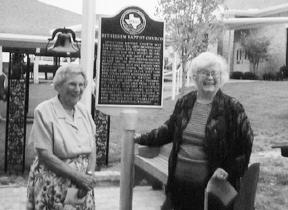
Betty Meeks and Clara Kinamon were two of many on hand for the unveiling of a historical marker from the Texas Historical Commission at Bethlehem Baptist Church in Farmersville this summer. The church was established in 1854, but dwindled to just Meeks and Kinamon before a resurgence in recent years saw hundreds attending again. Billy Harris is pastor.

bluebull Rittenhouse Church in Houston, 50th, Oct. 18-19. Several former pastors have confirmed they will be in attendance. Former members are asked to provide contact information at (713) 695-3463 or maxine@rittenhousebc.org. Clay Bowers is pastor.

Events

bluebull Alex and Janice Powell were commissioned as Mission Service Corps volunteers at First Church in Canyon Lake.

bluebull First Church in Sugar Land held a groundbreaking and dedication service at the new property Sept. 7. Scott Rambo is pastor.

bluebull “Christ, Our Single Focus” will be the theme for a singles conference to be held from 9 a.m. until 6 p.m. Sept. 13 at First Church in Baytown. Speakers include Don Piper, John Redmond, John Sherrill, Linda Boone, Mike Schumacher, Becky Bridges, Larry Collison, Gary Peil, Bill Sicloa, Tina Wash and Gale Yandell. Topics include “Grieving and Growing Through Divorce,” “Single Parenting,” “Dating Today” and others. The cost is $30. To register call (281) 422-3604.

bluebull Brentwood Church in Houston will hold special services and a picnic to celebrate the church's 38 years of service to the community Sept. 21. Joe Samuel Ratliff is pastor.

bluebull Vance Greek, “The Golden Voice of Branson,” will perform in concert at First Church in Wimberley Sept. 23 at 7 p.m. Bill Jones is pastor.

bluebull New Hope Church in Cleburne will hold a camp meeting Oct. 19 at 10 a.m. A trail ride beginning at 8 a.m. will precede the morning service. Dennis Swanberg will be the guest speaker for the event and No Turning Back the guest musicians. For more information, call (817) 645-8765. David Marchbanks is pastor.

Retiring

bluebull Merle Blado, as pastor of First Church in Sealy, Aug. 31. He was the church's pastor 33 years.

Deaths

bluebull Dorothy Green, 82, Aug. 3 in Lubbock. She was the wife of retired pastor Lomer Green, who served in Louisiana, El Paso, Fort Hancock, Ashland, Big Spring, Kermit and Odessa. She is survived by her husband; brother, Joe Welzel; daughters, Beverly Vincent and Marie Vaughn; sons, Fred and L.D.; and eight grandchildren.

bluebull Era Skaggs, 97, Aug. 18 in Plainview. She was a graduate and also a biology instructor at Simmons College, now Hardin-Simmons University. The newly renovated HSU faculty-staff lounge in the Moody Student Center is dedicated to Skaggs and her sisters, Euna and Eva. Her sisters were long-time professors at HSU. A long time resident of Abilene before moving to a hospice in her last days, she was a member of First Church in Abilene. She was preceded in death by her husband, Roy; brothers, J.W. and John Paul Rudd; and her sisters. She is survived by her son, Skipper Skaggs; daughter, Lannie Cook; five grandchildren; and six great-grandchildren.

bluebull Vivian Reagan, 79, Aug. 20 in San Angelo. A missionary to Colombia and Ecuador from 1949 to 1954, her first husband, Julius Hickerson, died in a plane crash in the Andes Mountains in 1951 on the way home from planning a new seminary in Cali, Colombia. After completing a term in Cartagena and Cali, and another in Guayaquil, Ecuador, she taught in public schools across Texas. She moved to Baptist Memorials Center upon retirement. She was preceded in death by her second husband, Jake Reagan, in 1996. She is survived by her daughter, Julianne Williams; brothers, Lindsay and J.W. Dunn; and three grandchildren.

bluebull George Sill, 56, Sept. 2 in Waxahachie. He was a member of First Church in Waxahachie. He is survived by his wife, Becky; son, George Jr.; and one grandson.

Licensed

bluebull Bill Spriggs and D. Lowrie to the ministry at Liberty-Eylau Church in Texarkana.

Ordained

bluebull David Jackson to the ministry at Lexington Church in Corpus Christi.

bluebull Terry Burnett to the ministry at Brighton Park Church in Corpus Christi.

bluebull Rayford Smith to the ministry at San Patricio Church in San Patricio.

bluebull Terry Whitmire and John Dix Jr. as deacons at Mount Sinai Church in Corpus Christi.

bluebull Andy McCormick, William Moroz and Derrell Smith as deacons at Chalk Bluff Church in Waco.

bluebull Mike Lonigro and Jason Nichols as deacons at First Church in Canyon Lake.

bluebull Randy Epps, Doyle Landers, Harlan Midriff, Ray Miller, Raymond Patton, Jim Shaw and Robert Wagoner as deacons at Holly Brook Church in Hawkins.

bluebull Colin Bailey, Philip Crawford, Newman Lloyd, Bruce Pescshel and Milton Smith as deacons at First Church in Hillsboro.

bluebull Richard Pafford and Darrel Wallace as deacons at Turnersville Church in Gatesville.

Revivals

bluebull First Church, Hughes Springs; Sept. 7-10; evangelist, Paul Burleson; music, Michael Bridges; pastor, Mickey Rorex.

bluebull Black Jack Church, Rockdale; Sept. 12-14; evangelist, Billy Don Klinglesmith; pastor, Jimmy Haile.

bluebull Indian Hills Church, Grand Prairie; Sept. 14-17; bluebullevangelist, Clark Bosher; music, Jim Cash; pastor, Doug Simon.

bluebull First Church, Harker Heights; Sept. 17-21; bluebullevangelist, Wes Massey; bluebullmusic, Don Thornton; pastor, Jay Thomas.

bluebull Second Church, Abilene; Sept. 17-21; evangelist, John Prim; music, Jack Staples; pastor, Joe Prim.

bluebull Ivanhoe Church, Ivanhoe; Sept. 21-24; bluebullevangelists, Cody and Laurie Deevers; pastor, Craig Ludwig.

bluebullvocational evangelist

News of religion, faith, missions, Bible study and Christian ministry among Texas Baptist churches, in the BGCT, the Southern Baptist Convention ( SBC ) and around the world.