Around the State_71403

Posted: 7/11/03

Around the State

Kyle Reese, pastor of First Church in San Angelo, recently received the doctor of ministry degree from Northern Baptist Theological Seminary in Lombard, Ill.

Anniversaries

bluebull Clear Fork Church in Weatherford, 145th, June 8. Randy Edwards is pastor.

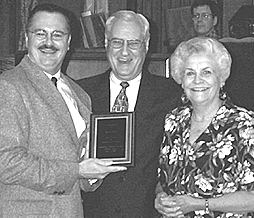
Southwest Church in DeSoto recently honored Kay Cox for 47 years of teaching Sunday School. Pastor Bruce Smilie and Benny Mayo, minister to senior adults, made the presentation.

bluebull Charlotte Watson, fifth, as minister of missions/member assimilation at First Church in Georgetown, July 1.

bluebull Pam Emmert, fifth, as minister of children at First Church in Georgetown, Aug. 1.

Retiring

bluebull F.M. Byford, as minister to older adults at Paramount Church in Amarillo, June 30. He has served the Amarillo church 18 years. His prior service includes eight years as minister of education at First Church in Sapulpa, Okla., and 25 years as pastor of various Oklahoma churches. He celebrated 50 years of ministry last January. He will continue to live in Amarillo.

bluebull Frankie Rainey, as pastor of Crestmont Church in Burleson, Aug. 31. He will teach at Howard Payne University, where he previously taught for 14 years. He has served the Burleson church 10 years. He was pastor of other Texas churches 22 years before going to HPU.

bluebull Norman and Gunita Harrell, as International Mission Board missionaries. They are on their final stateside assignment in Benbrook. The Harrells have served as missionaries 35 years, 32 of which were spent starting churches in Portugal. Prior to serving in Europe, the couple served as North American Mission Board workers in Alaska two years. He also was pastor of Chisholm Church in Terrell from 1967 to 1971. They will retire officially in December. Until then they can be reached through First Church in Benbrook.

Deaths

bluebull Bernie Ash, 81, in Alice May 15. She was the wife of Texas pastor Joe Ash, who died in 1987. They lived in many Texas towns while ministering, including Nacogdoches, Orange Grove, Hebbronville and Houston. She was active in WMU on both the church and associational level. At the time of her death, she was a member of West Main Church in Alice. She is survived by her son, Joe; daughter, Karen Bishop; five grandchildren; and four great-grandchildren.

bluebull Caleb Morgan, 19, June 18 in Temple after an automobile accident. He recently completed his freshman year at the University of Mary Hardin-Baylor and was serving as minister of music at Grace Temple Church in Waco. He is survived by his parents, Mary Jane and Bud Morgan, and sister, Hannah Morgan.

bluebull Orba Lee Malone, 82, June 27 in El Paso. An El Paso attorney, Malone was an active Baptist layman. At age 31, he became the youngest person ever elected to the Baylor University board of trustees. An early advocate of racial integration, he led in Baylor's admittance of the first black student/athlete in the Southwest Conference in 1964. Malone was such an ardent Baylor loyalist, his blood was once drained into green and gold buckets during a kidney removal nine years ago, family members recalled. He also served as a board member of Wayland Baptist University from 1982 to 1995 and the Baptist Standard from 1966 to 1978. He also served as chairman of the Christian Life Commission of both the Southern Baptist Convention and the Baptist General Convention of Texas. He also was a founding director and vice president of the board of trustees of the Lee and Beulah Moor Children's Home from 1957 to 2003. As an attorney, he helped hundreds of families in the adoption of children. He was a member of First Church in El Paso. He was preceded in death by his first wife, Peggy, in 1989. Also preceding him in death were his son, Paul and brother, R.C. He is survived by his wife, Lillian; sons, John, David and Dan; daughter, Carol Lorence; step-daughter, Laura Hoffman; brothers, Dawson, Doyle and Bill; sisters, Lucille Bailey, Evelyn Wood, Lecia Carroll and Ann Chaddick; and 11 grandchildren.

Licensed

bluebull Antonio Saenz to the ministry at Iglesia Emanuel in Bastrop.

Ordained

bluebull Keith Johnson to the ministry at First Church in Valley Mills.

bluebull Wally Wellborn to the ministry at Walnut Springs Church in Walnut Springs.

bluebull Steve Gunter to the ministry at Immanuel Church in Paris.

bluebull David Tankersley to the ministry at Center City Church in Goldthwaite.

bluebull J.T. Marsh as a deacon at West Park Church in Pecos.

Events

bluebull The Best Family will be in concert at Oran Church in Graford July 27 at 6:30 p.m. Wayne Livingston is pastor.

Revivals

bluebull Dogwood Hills Church, Woodville; July 20-23; *evangelists, The Cherrys; interim pastor, Bob Elliott.

bluebull East Cisco Church, Cisco; July 20-25; *evangelist, Herman Cramer; *music, Ernie Overstreet; pastor, C.P. Floyd.

bluebull Bethel Church, Plainview; *evangelists, The Cherrys; pastor, Q.D. Bevel.

*vocational evangelist

News of religion, faith, missions, Bible study and Christian ministry among Texas Baptist churches, in the BGCT, the Southern Baptist Convention ( SBC ) and around the world.


Appeals court tells Ten Commandments judge, ‘Thou shalt not’ _71403

Posted: 7/11/03

Appeals court tells Ten Commandments
judge, 'Thou shalt not'

By Robert Marus

ABP Washington Bureau

WASHINGTON (ABP)–The “Ten Commandments Judge” had better follow the commandment of the Constitution and remove his monument from the Alabama state judicial building, a federal appeals court said July 1.

A three-judge panel of the 11th U.S. Circuit Court of Appeals ruled unanimously that Alabama Chief Justice Roy Moore's installation of a 5,280-pound Ten Commandments monument in the rotunda of the state judicial building violates the First Amendment's prohibition of state support for religion. They upheld a lower federal court's ruling that the monument must be removed, although the appeals court did not impose a timetable for its removal.

The court vehemently rejected Moore's argument that the federal courts have no authority in the matter because he is sworn to uphold both the Alabama and federal constitutions. Moore argued that both documents acknowledge God.

The court likened Moore's argument to similar arguments by segregationist Southern governors in the 1950s and 1960s in their attempts to defy federal court orders integrating schools and other public facilities.

After noting that former Alabama Gov. George Wallace and former Mississippi Gov. Ross Barnett ultimately were forced to obey federal decrees, Judge Ed Carnes wrote in the court's opinion, “Any notion of high government officials being above the law did not save those governors from having to obey federal court orders, and it will not save this chief justice from having to comply with the court order in this case.”

Carnes went on to say bluntly that Moore would not be allowed to defy federal courts.

“The rule of law does require that every person obey judicial orders when all available means of appealing them have been exhausted. The chief justice of a state supreme court, of all people, should be expected to abide by that principle. We do expect that if he is unable to have the district court's order overturned through the usual appellate processes, when the time comes Chief Justice Moore will obey that order.

“If necessary, the court order will be enforced. The rule of law will prevail,” Carnes concluded.

Moore had the monument placed in the building in the middle of the night July 31, 2001, without the knowledge or consent of his fellow justices. It stands by itself at the center of the building's main public space, and Carnes noted in his opinion that visitors and employees sometimes kneel in prayer before the monument, as if the room were a chapel.

Inscribed across the top of the monument is the Protestant King James translation of the commandments. The court's opinion took special note that different religious traditions–including different traditions within Christianity itself–have different ways of translating and arranging the Exodus passages from which the commandments are drawn. Therefore, the court said, it was difficult to view the sculpture as anything but an endorsement of Protestant Christianity.

The judges also said the monument failed another test of constitutionality–whether the state, as represented by Moore, had a secular purpose in erecting it. The court relied, as had the lower court, on Moore's own words both in court testimony and in a speech he gave at the monument's unveiling, to show he did not have a secular purpose in mind when he made the decision to place the monument in the building.

Privately raised funds paid for the sculpture, but Moore allowed a film crew from Coral Ridge Ministries–the Religious Right organization run by Florida-based televangelist James Kennedy–to tape footage of the monument's construction and installation. Coral Ridge later sold the videotape as a fund raiser and has paid for Moore's legal defense.

Moore has said he acted secretly to protect his fellow justices from being named in the lawsuit he was certain would result from his actions.

News of religion, faith, missions, Bible study and Christian ministry among Texas Baptist churches, in the BGCT, the Southern Baptist Convention ( SBC ) and around the world.


Baylor vision sparks change and questions_71403

Posted: 7/11/03

Baylor vision sparks change and questions

By Mark Wingfield

Managing Editor

WACO–Baylor University is changing. Everyone affiliated with the university seems to agree on that.

Whether that change is for the better or worse, however, sparks intense debate among Baylor loyalists.

See Related Stories:
Baylor vision sparks change and questions


Baylor direction sparks debate_p2_71403

Posted 7/11/03

Continued
Return to previous page

Baylor direction sparks debate

One male assistant professor responding anonymously to the survey wrote: “Baylor must do something to help tenure-track faculty (new hires) cope with the large numbers of tenured senior level professors who do not support the current goals/directions of Baylor–thus do not support those of us brought in to Baylor to fulfill the current mission. There is a serious and negative interaction between new and old faculty in this regard.”

Job satisfaction

Tension between A and B faculty, combined with questions about the wisdom of implementing the 2012 vision, appear to be contributing to a less-than-ideal work environment at Baylor.

The February survey of faculty found only a quarter believe there is a high level of trust within the university. More than half (57 percent) said they disagree with the statement, “I feel there is a high degree of trust within the university.”

See Related Stories:
Baylor vision sparks change and questions
Regents to hear from committee investigating member's conduct
What is a tier-one school?
The top 50 schools

Trust levels vary, however, when examined from different angles. Faculty report they are much more likely to trust colleagues within their departments, for example. And new hires are more likely than veteran faculty to express trust in the university as a whole.

Among tenured faculty, the veterans, only 29 percent expressed confidence in the direction the university is going. That compares to 67 percent of tenure-track faculty, which includes the new hires.

An executive summary of the survey published on Baylor's website noted: “All these elements point to challenging circumstances for both faculty and administration. Many tenured faculty do not have confidence with the direction of change and are feeling undervalued. A clash of cultures is evident among A and B faculty. At the department level, this situation is better but potentially divisive as tenure-track faculty fear conflict and promotional difficulty because of their alignment with senior administration. These factors present extremely demanding situations for department chairs, who must manage the culture change on the local level.”

Sloan said he was not surprised to learn faculty expressed more confidence in those they work more closely with than with senior administration. On this point, the survey “gave what anyone would expect,” he said.

Regarding the low levels of overall trust for the university found among faculty, Sloan said, Baylor has little comparative data from other universities. Baylor is only the third university he knows of that has conducted such a survey.

“It may be that our numbers are good compared to other universities,” he reasoned. “We just don't know.”

At the least, Sloan said, Baylor should get credit for undertaking the survey. “I'm very proud of Baylor for being willing to do that.”

President from within

An irony of the tension between the president and faculty is that Sloan himself rose to leadership from the faculty ranks–and he was championed by some of the regents who now are his harshest critics.

In 1995, Herbert Reynolds announced his intention to retire from the presidency at the conclusion of the 1995-1996 academic year. In November 1995, the regents' presidential search committee brought a candidate to the full board for consideration. However, after two days of meetings, the regents adjourned without taking action on the nomination of Tom Corts, president of Samford University in Birmingham, Ala.

By some accounts at the time, Corts did not gain the full support of the board because he had no Texas ties and was not a Baylor graduate. Some faculty also opposed his hiring.

Three months later, the Baylor regents met again as a committee of the whole and interviewed five candidates, settling on Sloan as their choice by a narrow vote on the second day.

Two of Sloan's foremost advocates were Jaclanel McFarland, the regent now under investigation, and John Wilkerson of Lubbock, immediate past chairman of the board and a strong critic of Baylor's current direction.

Were it not for Wilkerson and McFarland, Sloan perhaps would not be president of Baylor today.

Donations to Baylor

2003 $46,077,000
2002 $41,327,000
2001 $52,927,000
2000 $57,661,000
1999 $41,483,000
1998 $34,381,000
1997 $59,173,000
1996 $19,093,000
1995 $23,644,000
1994 $28,754,000
1993 $18,932,000

Sloan came to the presidency from Baylor's Truett Seminary, where he served as founding dean after 10 years of teaching in the university's religion department. Prior to that, he taught at Southwestern Baptist Theological Seminary in Fort Worth and Hardin-Simmons University in Abilene.

According to his biographical information provided by the university, Sloan “has authored two books, assisted with editing of several books and published more than 50 articles and chapters for scholarly or ecumenical journals and publications.”

Asked if he could meet the criteria for hiring as a Baylor professor today, Sloan responded affirmatively.

“I think I could be hired,” he said. “I think I have the academic credentials, and I have the research record and commitment to teaching and a love for a place like this.”

Bricks and mortar

Baylor 2012 calls not only for building faculty but for building buildings. Foremost among them is a four-story, 500,000-square-foot facility to provide classrooms, laboratories and faculty offices for science studies. The building plans also include parking garages, recreational facilities and number of residential buildings.

Baylor has not added any new student housing in nearly 40 years, meaning only freshmen normally live on campus. A component of the 2012 vision is to increase a sense of campus community by adding 1,800 new beds in on-campus housing.

All the construction comes with a price tag, and that has created another swirl of concern.

Last year, the Baylor regents approved a $246 million bond issue, combining $56 million in existing debt with $190 million in debt. The bulk of the new funds, $105 million, will pay for the science building, currently under construction.

“The debt is tremendously worrisome, unprecedented in Baylor's history,” Prichard said. “I was on the board when we voted to proceed with the … science building. The plan was to start even without funding but to raise the money through foundations. However, that has been singularly unsuccessful.”

Acquiring the debt may be water under the bridge now, but it could prove to be treacherous water unless more donors sail to Baylor's rescue, Prichard predicted. “Baylor could reverse everything, fire Robert, elect new regents, but the debt remains. It's about 50 percent of the endowment. Barring a $100 million gift to pay for the science building, any administration is going to be saddled with the debt for years to come.”

Sloan views the debt from a different perspective, not in relation to endowment but in relation to annual budget. From that vantage, he said, the debt isn't nearly such a threat. It is, instead, a properly used tool to advance the university's mission.

“Families and businesses and institutions of higher learning and churches regularly use debt to forward their mission,” Sloan said. While Baylor historically has not taken on major debt, the time was right to do so now, he added, explaining that Baylor entered the bond market “at an all-time historic low” and borrowed far less than it could have.

The blended rate of the bond issue is 3.8 percent, he said.

“We spend the grand total of 4.7 percent of our operating budget on debt retirement. I suspect the average Baptist family would love to have a house mortgage and credit cards, car loans and everything else add up to 4.7 percent of their monthly budget.”

Baylor had to move forward with the science building to remain competitive in recruiting students, he said, explaining that the current science buildings were constructed in the mid-1960s.

“We've had students come to campus and look at our science buildings and say, 'I had better laboratories at my high school,'” he said.

The flipside of Baylor entering the bond market at all-time low interest rates is that Baylor has taken on major capital projects at a time when donations are drying up due to the sagging stock market.

The 2012 vision calls for increasing the university's endowment from $645 million to $2 billion. Yet donations to Baylor have been on a downward trend in recent years rather than an upward trend.

The high point in Baylor's fund-raising efforts came in 1997, when donors gave $59.2 million. Donations swung up and down for the next few years, cresting again at $57.7 million in 2000, two years before the 2012 vision was launched.

The next year, donations dipped to $52.9 million, then $41.3 million and settled at $46.1 million for the academic year just ended.

Sloan acknowledged the nation's economic downturn has hurt fund raising. However, for Baylor to raise more than $40 million in a bad economy is a positive sign, he said.

“Fund raising is going very well,” Sloan said, adding that the current campaign to raise $500 million by 2005 has secured cash and pledges of $444 million.

Tuition

All financial discussions at Baylor these days ultimately lead to tuition, however. The new tuition structure implemented through Baylor 2012 lights up alumni critics more than anything else.

Beginning in the fall of 2002, Baylor adopted a flat-rate tuition rather than charging based on the number of semester hours a student takes. That rate started out at $15,700 per year–a 29 percent jump from what had been charged for a typical course load–and now stands at $17,200 per year.

Tuition is projected to continue increasing 6.8 percent annually through 2012, meaning it could top $30,000 per year for the entering class of 2012.

Alumni and other critics believe this makes Baylor inaccessible to average Texas Baptist families.

“Baylor used to be one of the most affordable major universities in the nation, but it's now tied with Rice as the second (to SMU) most expensive school in the state,” said Miller, the Highland Park high school teacher. “Baylor has been one of the state's biggest producers of teachers, which are chronically short in supply. I wonder how many future teachers will be able to afford the level of debt they will have to incur now to attend Baylor. And how many children from Texas Baptist families headed by teachers or pastors or small-businessmen will still be able to afford a Baylor education?”

According to Sloan and other Baylor administrators, the tuition increase actually has made Baylor more accessible to middle-class students and Baptist students than before.

Although the cost of tuition has increased, the amount of financial aid offered also has increased. Prospective students should not be scared off by the “sticker price” of a Baylor education, Sloan said, but should find out what the actual cost would be for them.

“Because of the increased amount of financial aid available, the out-of-pocket issue is the real issue. … What people really want to know is, 'What does it cost me?'”

Despite perceptions to the contrary, “Baylor is more accessible to the middle class today than it was three years ago,” Sloan said. “I know that may be counter-intuitive, but those are the facts.”

The unspoken math behind this equation is that charging a higher price to students who are able to pay it allows the university to more deeply subsidize the cost for students who are not able to pay the full price.

This is a “longstanding practice” in higher education, Sloan said. “We give scholarships not only out of our endowment, but we also give scholarships out of our operating budget.”

According to statistics provided by Baylor, the average and median household incomes of entering freshmen have dropped over the past two years. That data is based on financial aid forms, however, meaning students from families who are able to pay the full tuition are not counted.

Baylor spokesman Larry Brumley, acting vice president for university relations, said leaving off those “full pays,” which numbered 521 last year, should not significantly skew the analysis. The number of full pays actually decreased last year, while need-based financial aid increased, he said.

Comparatively, Baylor is the highest-priced Baptist school in Texas but it's still cheaper than the average second-tier private school in the United States, Sloan said.

He sells it as a value. “Right now, you're getting a middle to top second-tier education for a below-average second-tier price,” he said, explaining that the average tuition for a second-tier private university is $27,000, compared to Baylor's $17,200.

Baylor's tuition also remains lower than other leading private schools in Texas, including Rice, SMU, TCU and Trinity, he said. “We're a great value. We have been. We still are.”

Recruiting freshmen

A key to making the annual budget goals at Baylor, however, is bringing in freshmen and transfer students each year. With the carefully crafted tuition increases slated to make the 2012 vision a reality, meeting enrollment goals has become vital.

Baylor's support staff members have been told they may not receive salary increases this year if new-student enrollment falls short in September.

Last year, Baylor missed its goal for incoming students by about 225, or about 8 percent, Sloan acknowledged. That represents several million dollars in lost tuition income.

Because students who were enrolled at Baylor before the flat tuition was introduced were grandfathered in, bringing in new students each year at the higher tuition rate provides a greater financial boost to the university.

Critics question why Baylor appears to be having trouble recruiting enough freshmen if the university is in fact more accessible to average families than before.

Anecdotal evidence abounds from critics, alumni and other observers to indicate the higher sticker price at Baylor shuts the door on consideration early on.

An alumnus quoted without attribution in Miller's compendium of comments sent to regents wrote: “Several students in our congregation, previously destined for Baylor, have had to change their plans because of the prohibitive new tuition. Our pastor is suggesting they investigate several of the other Texas Baptist colleges and universities.”

“In my church, families are not looking at Baylor because of the costs,” said Prichard, who attends First Baptist Church of Corpus Christi. “The emotional tie between Baylor and Texas Baptists is weaker than ever before.”

Sloan insists the tuition is not driving students away from Baylor. “We had enough applicants last year to have made our class,” he said. “But we didn't. We missed for operational reasons.”

This year's entering class looks more promising, he said.

Brumley confirmed that deposits have been received from 2,789 potential freshmen, slightly over the budget goal of 2,775 freshmen. Baylor's admissions office has a goal of 2,800 freshmen for this fall.

Recruitment of transfer students is still lagging, however, with deposits from 368 toward a budget goal of 500.

Some faculty have expressed concern that to get freshmen numbers up to the budgeted levels, the university has loosened its admissions standards by taking in record numbers of what insiders call “special admits” or “challenge students.”

Weaver said at least 15 percent of the incoming freshman class will be challenge students, a trend he and others view as running counter to Baylor's quest to achieve tier one status.

According to critics, this is the point at which Baylor's debt overrides its ability to be selective.

“Baylor has become so tuition-dependent that tuition is needed to pay the debt,” Prichard said.

Physics professor Don Hardcastle recently explained to the Waco Tribune-Herald that it now takes the tuition of 900 students to pay the university's debt service.

Sloan pointed to an increase in average SAT scores among Baylor freshmen as an indicator that the student body is getting brighter, however.

The average SAT score has increased from about 1140 to about 1180, he said. While the university doesn't have a published threshold of required SAT scores for admittance, the average scores have risen by increasing the pool of applicants to Baylor, he said.

“The more people apply, the greater the demand,” he explained. “That tends to raise” the SAT scores.

Financial status

Despite the growth and building and changes at Baylor, the university remains in excellent financial health, Sloan said. “We're just closing the books on our fiscal year, and for the 34th year in a row, Baylor finishes in the black. We have a strong, not huge, but strong surplus.”

Chief Financial Officer David Brooks likewise assessed the university as fiscally healthy.

Baylor's internal operating budget ended the 2001-2002 academic year with a $2.8 million surplus, he said, and the 2002-2003 year closed May 31 with a $1.35 million surplus.

The operating budget is an internal document that is not published or made available for outside review to anyone other than auditors and the board of regents. Brooks said the operating budget encompasses the actual income and expenses of running the university, excluding gifts to endowment and capital projects funded outside the operating budget.

According to Baylor's audited financial statements for the 2001-2002 academic year, which are published, the university experienced a $33.4 million increase in net assets before adjustments required by generally accepted accounting standards and a $46.3 million decrease in net assets after adjustments.

The financial statements show the bulk of that loss was due to a $62.67 million decrease in market value of investments.

Brooks acknowledged that Baylor, like all universities and non-profits with endowments, has suffered major losses on investments in recent years. However, investment income was turning around near the end of the fiscal year just ended, he said, with Baylor's endowment gaining $55 million in value in April and May.

The total market value of Baylor's endowment currently stands at about $586 million, he said.

Alumni association

Baylor also has a wealth of alumni–more than 100,000 living. Many of those alumni are fiercely loyal to their alma mater, as is shown by their free-flowing critique of the administration.

However, as part of Baylor 2012, the administration set about to more regularly and directly communicate with that alumni base by creating a new alumni services division.

That was seen by Sloan's critics as a slap at the Baylor Alumni Association, an autonomous body with 25,000 dues-paying members.

University officials said they wanted to reach all alumni. Some leaders of the Baylor Alumni Association said the administration wanted to run the independent group out of business.

Under terms of an agreement recently signed by the Alumni Association and the university, the Alumni Association will continue to perform several duties, including publishing its magazine, the Baylor Line.

However, the association has lost $350,000 in annual funding from the university–money that has been diverted to the university's own alumni services work, which includes Baylor magazine, mailed to all alumni.

To Sloan's critics, this is further evidence of the administration's attempts at control. To Sloan's defenders, it was a logical step to strengthen the university's direct communication with alumni.

With that as a backdrop, several hundred alumni are expected for the July 18 “Baylor family dialogue” to be held at the Hughes-Dillard Alumni Center on campus. The event originally was scheduled as an alumni rally at the Waco Convention Center, designed to demonstrate the number of concerned alumni.

“They dismiss the complainers as a small group of disgruntled Baylorites,” explained Miller. “We want them to realize we're not a small group, that we represent a substantial number of people.”

Sloan said he plans to attend the dialogue, which will be streamed live on the Internet through the university's website. “We're not afraid of the facts,” he said.

The event will begin at 2 p.m. A news release from the Alumni Association bills it as “an event of substance and candid conversation.”

Todd Copeland, editor of the Baylor Line, said the Alumni Association stepped in to sponsor the dialogue in hopes of building bridges with all Baylor constituencies. “We hope to demonstrate the value of the independence we have fought to maintain,” he said.

The dialogue is open to all who are interested, he said.

Does tier-one status matter?

Baylor 2012 and its implementation no doubt will be a major topic of discussion at the alumni event.

Miller said she, for one, would like the university to reassess the 2012 vision.

“I'm not sure Baylor needs to worry about being on any magazine's list,” she said. “The university may have to sacrifice too much on the altar of the top tier and will be diverted from its longstanding mission of serving Texans and Baptists. I don't want to be a Protestant Notre Dame. I just want Baylor to go on being Baylor.”

Indeed, what Baylor was and is stands at the center of the current debate.

“I believe the growing divisiveness in the Baylor family today transcends any one person or any temporal administration and goes to the heart of what Baylor University is about, has been about and should be about in the future,” explained Gilbreath in one of his essays.

The administration and its critics seem to agree wholeheartedly on this point.

Brumley summarized the debate in one sentence: “This is a struggle for the heart and soul of the university.”

See previous page of Baylor article here.

News of religion, faith, missions, Bible study and Christian ministry among Texas Baptist churches, in the BGCT, the Southern Baptist Convention ( SBC ) and around the world.


Regents to hear from committee investigating member’s conduct_71403

Posted: 7/11/03

Regents to hear from committee

investigating member's conduct

By Mark Wingfield

Managing Editor

WACO–Baylor University's 36 regents will convene in Waco July 16 to hear a much-anticipated report from a committee appointed to investigate the conduct of regent Jaclanel McFarland.

At the last regents' meeting, May 16, McFarland was accused of tipping off students about an undercover drug operation on the Baylor campus–a charge she denies.

Who made the accusation and most of the details of how the regents are conducting the investigation has not been made public. The issue was discussed behind closed doors, and both university administrators and regents' officers have declined to discuss it publicly, citing a requirement of confidentiality.

See Related Stories:
Baylor vision sparks change and questions
Regents to hear from committee investigating member's conduct
What is a tier-one school?
The top 50 schools

The identities of those on the investigative committee have not been released.

However, regents reportedly have been called to a special session Wednesday morning to hear the investigative committee's report. The called meeting, to be held behind closed doors, will precede the regularly scheduled summer regents meeting by just a few hours.

McFarland, a Houston attorney who serves on the Baylor board in a slot elected by the Baptist General Convention of Texas, has acknowledged the accusations against her but has declined to discuss details of the regents' previous executive session with the media.

The Waco Tribune-Herald has reported extensively on the matter, and it has been reported in the Houston Chronicle and other Texas papers, as well as through the Associated Press.

In the days leading up to this week's regents meeting, speculation mounted that the investigative committee might recommend no action against McFarland because they had found no evidence against her.

All McFarland would say is, “If there is any evidence, they have yet to tell me.”

Both the chairman of the investigative committee and then the whole committee reportedly met with McFarland around the last week of June. They also reportedly interviewed McFarland's 22-year-old son, Allen, who is in Costa Rica on a Baylor study program this summer.

The Baylor drug sting, which ended April 19 with seven arrests, apparently was not as successful as Baylor police had hoped. Five of the seven were charged with misdemeanors, and only two were charged with felonies–a relatively small haul for a year's worth of undercover work.

The 22-year-old undercover drug officer, who posed as a student and lived in Baylor's Penland Hall, dated a female Baylor student and joined a fraternity.

Allen McFarland was a member of the same fraternity, Tau Kappa Epsilon, although he was not enrolled at Baylor during the last academic year. Baylor officials reportedly believed McFarland learned of the undercover operation in her role as a regent, informed her son, who in turned warned other members of the fraternity.

Both McFarland and her son deny those allegations. McFarland said she did not know about the sting until it was reported on the news. Other regents have suggested it is unlikely she could have known about it in her role as a regent, since they also knew nothing about it.

Numerous Baylor students have told the Baptist Standard and other media that they knew or suspected the undercover officer's true identity for months.

The accusations against McFarland sparked intense interest in Texas Baptist life and have served as a rallying point for alumni and others already critical of Baylor's administration. McFarland and others have suggested this is an attempt to remove her from the board because she has been critical of President Robert Sloan.

The regents themselves reportedly were divided on whether to take up the investigation against McFarland.

Former regent Ella Prichard of Corpus Christi, a vocal critic of President Robert Sloan, wrote a letter to all regents June 11 in which she called the investigation “not very smart.”

“Anyone who knows Jaclanel well knows that she would never slink quietly away from a personal attack unless there were solid evidence against her,' Prichard wrote. “The board has sparked a media frenzy and created a public forum for the airing of every grievance against the current administration.”

Prichard warned that McFarland “has been publicly defamed, and everything she holds dear is threatened–her law license and livelihood, her family structure, her standing at Baylor and with Texas Baptists, perhaps even her health.”

Some have speculated that McFarland could sue the university or even individual accusers for defamation of character or slander. She has declined to say publicly whether that is likely.

Meanwhile, Baylor has been publicly criticized by the parents of a freshman who was a roommate of the undercover officer. They have suggested the university endangered their son by placing the drug officer in his dorm room without the student's knowledge.

Although Sloan has declined to discuss the McFarland matter in the media, he did answer questions about the practice of placing undercover drug agents in the student population.

“I don't apologize for going after drug dealers,” he said. “We were not out there looking for nits. I don't think Baylor should apologize to anybody for trying to cooperate with law enforcement agencies who are trying to go after the cancerous evil predators who try to prey upon our children and our students.”

Although critics of the drug sting contend it was instigated by and conducted by Baylor alone, Sloan said the university chooses to cooperate with local law enforcement.

“Law enforcement agencies can and will carry out their operations on university campuses with or without the permission of the university,” he said. “We have historically cooperated because these agencies can and will do this without our permission–everything from federal agencies to state agencies.”

He added: “We prefer to cooperate (because) we think we can provide better insight into the nature of our campus and we can operate in a preventive way to try to limit potential unintended consequences.”

If the investigative committee were to recommend McFarland's expulsion over the matter, Robert's Rules of Order spell out the process for a trial, noting: “A member has the right that allegations against his good name shall not be made except by charges brought on reasonable ground. If a member is thus accused, he has the right to due process–that is, to be informed of the charge and given time to prepare his defense, to appear and defend himself, and to be fairly treated.”

The parliamentary manual further states: “A member who votes for a finding of guilty at a trial should be morally convinced of the existence of this kind of guilt on the part of the accused, on the basis of the evidence he has heard.”

For expulsion of a member, a two-thirds vote is required, meaning 24 of the 36 regents would have to vote to expel.

News of religion, faith, missions, Bible study and Christian ministry among Texas Baptist churches, in the BGCT, the Southern Baptist Convention ( SBC ) and around the world.


What is a tier one school?_71403

Posted: 7/11/03

What is a tier one school?

Baylor University's quest to become a “tier one” school refers to annual rankings published by U.S. News & World Report.

The rankings are determined by a formula established by the magazine and have no sanction from any academic organization or accrediting agency. They are, however, highly influential in the quest to gain recognition, donors, faculty and students.

The magazine reports that its formula is “based on our non-partisan view of what matters in education.”

Baylor competes among the nation's 249 national universities with doctoral programs. These are schools that offer a full range of undergraduate majors, plus master's and Ph.D. degrees, and emphasize faculty research.

See Related Stories:
Baylor vision sparks change and questions
Regents to hear from committee investigating member's conduct
What is a tier-one school?
The top 50 schools

Many other Baptist colleges and universities compete among the nation's 217 liberal arts colleges that focus almost exclusively on undergraduate education. Some compete among the 573 universities that offer a full range of undergraduate degrees and some master's degree programs but few doctoral programs.

U.S. News gathers data from each school on up to 16 indicators of academic excellence. Each factor is assigned a weight that reflects the editors' judgment about how much that measure matters.

The indicators used to capture academic quality fall into seven categories–assessment by administrators at peer institutions, retention of students, faculty resources, student selectivity, financial resources, alumni giving, and “graduation rate performance,” the difference between the proportion of students expected to graduate and the proportion who actually do.

The formula gives the greatest weight (25 percent) to the opinion of the presidents, provosts and deans of admission at peer institutions.

Based on these rankings, schools in each category are placed in tiers. In Baylor's category, each tier includes 50 schools. Those in the first tier are ranked in order. Those in the second and third tiers are not assigned specific rankings within those tiers.

News of religion, faith, missions, Bible study and Christian ministry among Texas Baptist churches, in the BGCT, the Southern Baptist Convention ( SBC ) and around the world.


What are the top 50 schools?_71403

Posted 7/11/03

See Related Stories:
Baylor vision sparks change and questions
Regents to hear from committee investigating member's conduct
What is a tier-one school?
The top 50 schools

What are the top 50 schools?

1. Princeton University
2. Harvard University
Yale University
4. California Institute of Technology
Duke University
Massachusetts Inst. of Technology
Stanford University
University of Pennsylvania
9. Dartmouth College
10. Columbia University
Northwestern University
12. University of Chicago
Washington University in St. Louis
14. Cornell University
15. Johns Hopkins University
Rice University
17. Brown University
18. Emory University
University of Notre Dame
20. University of California ­ Berkeley
21. Carnegie Mellon University
Vanderbilt University
23. University of Virginia
24. Georgetown University
25. University of California ­ Los Angeles
University of Michigan ­ Ann Arbor
Wake Forest University
28. Tufts University
University of North Carolina ­ Chapel Hill
30. College of William and Mary
31. Brandeis University
University of California ­ San Diego
University of Southern California
University of Wisconsin ­ Madison
35. New York University
36. University of Rochester
37. Case Western Reserve University
38. Georgia Institute of Technology
University of Illinois ­ Urbana-Champaign
40. Boston College
Lehigh University
Yeshiva University
43. Tulane University
University of California ­ Davis
45. Pennsylvania State U. ­ University Park
University of California ­ Irvine
47. Pepperdine University
Rensselaer Polytechnic Inst.
University of California ­ Santa Barbara
University of Texas ­ Austin
University of Washington
Source: U.S. News & World Report,
"America's Best Colleges 2003,"
rankings for national universities
with doctoral programs.


Baptist Briefs_71403

Posted: 7/11/03

Baptist Briefs

Texans elected to Coordinating Council. Four Texans were elected to new terms on the Cooperative Baptist Fellowship's Coordinating Council. Elected to terms through 2006 as Texas representatives were Harriet Harral, a laywoman from Broadway Baptist Church in Fort Worth; Stacy Conner, pastor of First Baptist Church of Muleshoe; and Scott Collins, a member of The Crossings Baptist Church in Mesquite. Philip Wise, pastor of Second Baptist Church in Lubbock, was elected to a 2006 term as an at-large member. In a related action, Ella Prichard of First Baptist Church of Corpus Christi was elected to the board of the CBF Foundation.

bluebull Setzer named moderator-elect. Bob Setzer, pastor of First Baptist Church of Macon, Ga., has been named moderator-elect of the Cooperative Baptist Fellowship. He will become moderator in 2004, after the service of Cynthia Holmes of Missouri. Phill Martin, a layman from Dallas, has completed his term as moderator and will serve as immediate past moderator for the next year.

bluebull Black seminarians plan reunion. The Fellowship of Black Seminarians plans a reunion of Southwestern Baptist Theological Seminary students Aug. 28-30, at the seminary's Leadership Development Complex in Fort Worth. The event will focus on the theme "Celebrating Past Achievements, Embracing the Future." It will honor the life and legacy of Raymond Spencer, Southwestern's first black faculty member. The weekend will include a variety of seminars, luncheons and a conference banquet featuring Vernard Johnson, gospel saxophonist. To register, write to Box 22536, Fort Worth 76122-0536 or call (817) 923-1921.

bluebull FamilyNet ratings increase. The latest Beta Research survey of U.S. cable subscribers finds FamilyNet ranks first among women and second among adults 18-49 for high interest amid 36 emerging ad-supported cable networks. Both rankings marked improvement from FamilyNet's third-place standings in last year's study. FamilyNet is a subsidiary of the Southern Baptist Convention's North American Mission Board. The broadcast unit is based in Fort Worth.

bluebull Clark to Palm Beach Atlantic. David Clark, president of the North American Mission Board's FamilyNet broadcasting subsidiary since 1997, has been named president of Palm Beach Atlantic University in West Palm Peach, Fla. He succeeds Paul Corts, who left the university after 11 years for an appointment as U.S. assistant attorney general for administration in Washington, D.C. Bob Sutton, a broadcast veteran and FamilyNet board member, will lead a transitional leadership task force to find Clark's replacement. Prior to joining NAMB, Clark was president of KMC Media, a media strategy, production and placement company that worked with many national ministries. He was dean of the college of communications at Regent University in Virginia from 1988-91 and vice president of marketing for the Christian Broadcasting Network from 1982-87.

bluebull SBC candidate announces. It's 11 months until the Southern Baptist Convention convenes again for its annual session, but a candidate for president already has been announced. Florida Baptist Convention Executive Director John Sullivan announced that Daytona Beach pastor Bobby Welch, author of the popular FAITH outreach program, will be nominated for president when the SBC meets in Indianapolis next June. Jack Graham of Plano last month was elected to his second and final term as SBC president.

bluebull CBF draws 4,357. The Cooperative Baptist Fellowship's general assembly in Charlotte, N.C., June 24-26 drew 4,357 registered participants. While not the largest crowd ever to attend a CBF general assembly, CBF officials considered it a strong showing. By comparison, the Southern Baptist Convention annual meeting drew 7,077 messengers from among the SBC's 42,000 churches. The CBF draws support from about 1,700 churches.

News of religion, faith, missions, Bible study and Christian ministry among Texas Baptist churches, in the BGCT, the Southern Baptist Convention ( SBC ) and around the world.


Brisco named Logsdon dean_71403

Posted: 7/11/03

Brisco named Logsdon dean

By Jenny Hartgraves

Staff Writer

ABILENE–Tommy Brisco, Baylor University religion professor, has been named dean of Hardin-Simmons University's Logsdon School of Theology.

He will succeed Vernon Davis, who announced his retirement earlier this year.

Tommy Brisco

Brisco, a native of Hot Springs, Ark., taught master's and doctorate courses for Baylor's religion department the last two years. He has an extensive history at Southwestern Baptist Theological seminary in Fort Worth, where he taught biblical backgrounds and archaelogy from 1980 to 2001 and served as associate dean for special master's degrees and doctor of philosophy degrees from 1996 to 2000. He also taught at his alma mater, Ouachita Baptist University in Arkadelphia, Ark.

Brisco received the doctor of philosophy degree at Southwestern Seminary in 1981 and the master of divinity in 1973.

He served as pastor at First Baptist Church of Meunster and Crenshaw Baptist Church in Crenshaw, Miss.

Brisco is the author of numerous books and scholarly articles. His “Holman Bible Atlas,” received the Gold Medallion Book Award for a reference work from the Evangelical Christian Publisher's Association in 2000. Some of his other works include articles in “Encyclopedia of the Ancient World” and articles in “Eerdman's Dictionary of the Bible.”

Brisco has years of archaeological field experience and has served as a lecturer in Israel, the Middle East and Turkey. He assisted in the development and administration of the archaeological expedition at Tel Batash, Israel, and he has served as archaeological consultant for the Biblical Illustrator, collecting visual materials throughout the Middle East and Italy for publications.

Brisco and his wife, Judy, have a grown daughter and son.

News of religion, faith, missions, Bible study and Christian ministry among Texas Baptist churches, in the BGCT, the Southern Baptist Convention ( SBC ) and around the world.


Russian adoption again an option_71403

Posted: 7/11/03

Russian adoption again an option

By Heather Price

Buckner News Service

After three years of waiting, Buckner International Adoption Services has received accreditation to resume placing Russian orphans for adoption.

Buckner processed more than 100 Russian adoptions before July 2000, when the Russian government began requiring accreditation from all adoption agencies working in the country.

“Russia cares very deeply about their children and their orphanages and placing them with good families,” explained Tiffany Taylor, director of Buckner's Shoes for Orphan Souls program. “They now do extensive background checks with all the agencies that are involved.”

Russian orphans once again will be able to find loving families in America through the work of Buckner International Adoption Services.

Buckner received its accreditation June 25, opening the door for Buckner to help hundreds of Russian orphans find homes in the United States.

“Ongoing prayers and patience in the Lord's timing has kept us going, and it is awesome to see the door open for us to continue to help children,” said Debbie Wynne, director of international adoption services. “We are thrilled at the opportunity to continue Buckner's ministry of helping those precious Russian children join with forever families.”

Many Buckner adoptive families have been waiting anxiously for accreditation. “They have been praying this day would come,” Wynne said.

With the new system, Buckner can place children with families more quickly than previously.

“Now it has opened up the doors where we can do adoptions with the children in the same orphanages we are doing humanitarian aid,” Taylor said.

Buckner helps hundreds of orphanages in Russia through its Shoes for Orphan Souls project. The project, which began with the name “Shoes for Russian Souls,” has distributed more than 700,000 new shoes to orphans around the world.

Russia long has been a focal point of Buckner's work. The international adoption program began there in 1995.

“We know from our work in Russia that there are many, many wonderful children in the orphanages,” Taylor said.

Buckner International Adoption Services provides complete adoption services in China, Guatemala and Russia.

To celebrate receiving Russian accreditation, Buckner will host a reception July 22 at the Buckner International Adoption office, 4830 Samuell Blvd., from 5 p.m. to 6:30 p.m.

Families and their adopted Russian children will be attending. The public is invited to attend as well.

Immediately afterward, from 6:30 to 9:30 p.m., an orientation session will be offered for anyone interested in adopting internationally. The meeting is free, but reservations are suggested. Call Jean Barnes at (214) 381-1552.

“This is a great day for Buckner,” said Ken Hall, president of Buckner Benevolences. “But most of all, it is a super day for children in need of a family. God is smiling, and Jesus is pleased once more that people are allowing little children to come to him.”

News of religion, faith, missions, Bible study and Christian ministry among Texas Baptist churches, in the BGCT, the Southern Baptist Convention ( SBC ) and around the world.


CBF gains BWA membership despite SBC opposition_72803

Posted 7/14/03

CBF gains BWA membership despite SBC opposition

By Trennis Henderson

Kentucky Western Recorder

RIO DE JANEIRO, Brazil (ABP)–The Cooperative Baptist Fellowship was elected to full membership in the Baptist World Alliance July 11 despite strong opposition from Southern Baptist Convention representatives.

The 75-28 vote by the BWA General Council came two years after the CBF’s initial application for membership. The vote also followed a decision last month by SBC messengers to reduce BWA funding by more than 30 percent.

The flap over CBF’s membership escalated last year when SBC leaders voiced concerns about how the BWA membership committee handled CBF’s application. Rather than declining CBF’s application a year ago, committee members publicly outlined the steps necessary for CBF to qualify for membership in the global Baptist fellowship.

Membership committee Chairman Ian Hawley told participants at the BWA General Council meeting this summer in Rio de Janeiro that CBF leaders had fulfilled the requirements for membership by declaring last fall that "they have separated themselves from the structures and organization of the SBC." Additionally, CBF leaders submitted 20 "indicators" the fellowship is a separate Baptist body, including the organization’s own mission statement, funding channels and missions structure.

Hawley, director of international missions for Australian Baptists, expressed regret that the membership process contributed to heightened tensions. "We certainly did not have any intention of hurting or embarrassing the SBC," he emphasized.

Noting that committee members "agonized and prayed for guidance over this decision," Hawley added, "The membership committee is of the opinion that the necessary degree of separation from the SBC by the CBF has been met."

He said the committee determined that recommending CBF as a BWA member body was "the only fair and right decision that could be made."

Prior to the secret-ballot vote, SBC representatives sought to defer the vote until next year. They suggested that the CBF might be better qualified for associate membership, a new category to be considered next year that would include local churches as well as other Baptist groups such as state, regional or associational entities.

The primary issue is whether CBF is "eligible under our present rules of membership," responded Tony Peck, a representative from the Baptist Union of Great Britain. "If so, we ought to vote on it now."

General Council members declined to consider the motion to defer before voting by a margin of nearly 3-to-1 to accept the CBF as BWA’s newest member body.

CBF Coordinator Daniel Vestal described the vote as "a kind of validation by other Baptist bodies worldwide of our value, worth and place in the Baptist family. Baptist World Alliance is an important ministry, and I’m excited about being a part of it."

Charles Wade, executive director of the Baptist General Convention of Texas, noted, "The world Baptist family considered carefully the recommendation of their membership committee."

Accepting CBF despite the controversy surrounding its application demonstrates that "Baptists around the world clearly will relate to all the Baptist family," Wade added. "They do not want to play favorites."

Denton Lotz, BWA general secretary, said he believes the membership process was fair and appropriate.

"We are Baptists," he emphasized. "We believe in democracy. We believe in the will of the people. … We would just plead that we all love one another."

Four other groups–the Community of Baptist Churches of Eastern Congo, the Association of Baptist Churches in the Central African Republic, the Baptist Church of Bosnia-Herzegovina and the Fraternity of Baptist Churches in Cuba–were approved for membership without debate earlier in the session.

The five additions expand BWA’s global membership to 211 member bodies representing more than 46 million baptized believers worldwide.


Will SBC drop BWA membership in wake of vote to admit CBF?_72803

Will SBC drop BWA membership
in wake of vote to admit CBF?

By Trennis Henderson

Kentucky Western Recorder

RIO DE JANEIRO, Brazil (ABP)–The Southern Baptist Convention is a founding member of the Baptist World Alliance, a global Baptist organization established in 1905. With this summer’s vote to grant BWA membership to the Cooperative Baptist Fellowship, however, the SBC’s future involvement in the BWA is in doubt.

Paul Pressler and Paige Patterson, the chief strategists in the SBC’s fundamentalist shift since 1979, were among SBC representatives at the BWA General Council meeting in Rio de Janeiro.

During debate on CBF’s membership, Pressler accused CBF leaders of repeated statements critical of the SBC. "That is not the rhetoric that promotes harmony and promotes peace," he declared.

"If you want them and their theology, that’s your decision," Pressler told General Council members, "but it is not our decision to accept them."

In an interview moments after the 75-28 vote to accept CBF as BWA’s newest member body, Pressler described CBF as "a small, dissident, liberal group."

Patterson, a former SBC president and newly elected president of Southwestern Baptist Theological Seminary in Fort Worth, said after the vote, "If I had to make a guess, I would say that what probably happened today is they probably accepted 150 (CBF-affiliated) churches in order to bid goodbye to 42,000 (SBC churches). I would be surprised if that’s not the eventual result."

The CBF reports contributions from about 1,700 churches, most of which also support the SBC. About 150 churches affiliate with the CBF alone.

"The BWA has been drifting left now for 20 years," Patterson claimed, adding, "What you have here is a huge affirmation of their intention to continue in that direction."

"The BWA has a right to accept as a member whomever it wishes," he noted. "I affirm their right to do so. But I also say as the leftward drift goes on, Southern Baptists are going to find the compromise involved to be too much."

Those views stand in sharp contrast to perspectives voiced by CBF and BWA leaders.

"My sincere hope is that the SBC will not leave the BWA," said Daniel Vestal, coordinator of the Cooperative Baptist Fellowship. "CBF desires very much to work alongside the SBC in BWA as well as other Baptist bodies."

The relationship between the SBC and BWA is "much more complex than just saying CBF being admitted to membership will cause them to leave," Vestal said. "I think that would be too simplistic. If the SBC leaves BWA, I don’t see it as our fault. … Baptists have had disagreements about a lot of things in the past and still worked together."

Denton Lotz, BWA general secretary, said BWA leaders "regret any separation in the body and pray for unity."

"We continue to want to engage our Southern Baptist brothers and sisters in the world body which they were instrumental in forming," he added. "I believe we will continue to have a good relationship with millions of Southern Baptists in the U.S.A. and their mission around the world."