family_60203

Posted: 5/30/03

LifeWay Family Bible Series for June 8

Indicators of a growing disciple of Christ

Luke 9:23-24; Ephesians 4:29-5:10

By Tim Owens

First Baptist Church, Bryan

Following Peter's confessions of Christ at Caesarea Philippi, Jesus foretold his own death and resurrection. He then set forth the requirements of discipleship: “If anyone would come after me, he must deny himself and take up his cross daily and follow me. For whoever wants to save his life will lose it, but whoever loses his life for me will save it” (Luke 9:23).

In Ephesians 4:29-5:10, Paul contrasts the new life in Christ to the old way of life without Christ. Taken together, these two passages of Scripture address the questions, “What does it mean to be a mature disciple of Jesus Christ?” and, “What does it look like when a Christian is truly following Christ in all areas of life?”

study3

God's grace does not allow his people to live any way they want to live. Rather, God's grace empowers his people to live with the attitudes and actions of Christ. What are some of the signs of a growing disciple?

Deny self (Luke 9:23-24)

Christian discipleship begins with a personal commitment to pursue the life and the mission of Christ above everything else. Christians who live as Christ lived will every day put their own interests and desires into the background and accept wholeheartedly the sacrifice and suffering that may have to be endured in his service. The “cross” is not the ordinary, human troubles such as disappointments, physical illness, emotional stress, financial or vocational loss, etc. The “cross” would include anything that has to be suffered, endured or lost in the service of Christ. This might be persecution, self-sacrifice, suffering, even death as a result of obeying Jesus Christ.

Jesus made it clear that Christians who try selfishly to secure for themselves pleasure and happiness in life will in fact never find real joy or purpose in life. However, those who lay their lives on the altar in service to Christ, who strive for his glory and for the extension of his kingdom, will spontaneously find true joy and purpose in life. Both here on earth and forever in heaven.

Imitate God (Ephesians 4:29-5:2)

The apostle Paul is eager to explain in very tangible terms what it means to follow Jesus Christ. He cautions believers to recognize the power of the spoken language. He commands them to avoid dishonest, unkind, destructive and vulgar speech. William Penn said, “If thou think twice before thou speak once, thou will speak twice the better for it.”

In Ephesians 4:30, Paul is asking, “Why would anyone, who was sealed by the ownership of the Spirit, do anything to live contrary to him, offend him or hurt him?” Believers receive the seal of the Holy Spirit when they first surrender their lives to Jesus Christ. Believers are sealed at the moment of conversion until the day of redemption. In the in-between time, Paul commands us not to grieve the Spirit of God. The Holy Spirit hates sin, falsehood and language that tears people down. If Christians are going to follow Christ, they must also hate these things.

The call to Christian discipleship is to be kind, compassionate and forgiving toward others. Refusing to forgive is hazardous to one's Christian health. Forgiveness is a refusal to let a past wrong destroy a present relationship. Forgiveness is a rejection of bitterness, malice and revenge. Forgiveness is when Christians do unto others as Christ has done to them.

Avoid wrong (Ephesians 5:3-7)

The life of Christian discipleship is one of high standards. There is not any higher standard than Ephesians 5:1: “Be imitators of God”–imitate his kindness, his forgiveness, his unconditional love and his holiness. Believers are children of God. As such, they should take upon themselves the characteristics of the family to which they belong. Paul is calling believers to holy living in an unholy, godless age.

Holiness is not something that just happens. Rather, Christians are to take holiness upon themselves with intentionality. Read Ephesians 5:3-7 with the conviction that believers have the power to put off the old life of immorality and put on the new life of purity and morality. There should not even be a hint of these things in the minds, words and actions of Christians.

Paul was writing in an age in which believers were tempted to imbibe the sexual mores of the culture in which they lived. The same thing happens today! But through the power of God's Spirit, the believer can follow Christ in such a way that there is not even a hint of immorality, impurity or greed.

Do right (Ephesians 5:8-10)

Ephesians 5:8 is radical. Paul writes, “You are light in the Lord.” He does not say believers belong to the light or that they are in the light. He says strikingly: “You are light. Therefore, live as children of light.” Paul echoes the words of Christ: “You the light of the world. … Let your light shine before men, that they may see your good deeds and praise your Father in heaven” (Matthew 5:14-16).

Question for discussion

bluebull If you were measuring your growth, are you growing or have you tapered off?

News of religion, faith, missions, Bible study and Christian ministry among Texas Baptist churches, in the BGCT, the Southern Baptist Convention ( SBC ) and around the world.


explore_60203

Posted: 5/30/03

LifeWay Explore the Bible Series for June 8

Salvation comes through personal faith in Jesus

Galatians 2:4-5, 11-21

By Jim Perkins

Madison Hills Baptist Church, San Antonio

Our zeal in life is often misguided. People waited in line for an hour recently for the promotional sale of gasoline at our new neighborhood grocery store. To save a quarter per gallon, they wasted an hour–and probably a gallon of gasoline! We need a more vital arena in life to invest our energies.

Set a good example

The Apostle Paul invested wisely–he maintained a consistent, God-given zeal for the defense of the “truth of the gospel” (2:5, 14). As becomes obvious in this passage, the message of the gospel centers around a simple yet life-changing truth: Salvation comes through a personal faith in Christ as Lord and Savior.

study3

The second chapter of Galatians includes a description of two key events in the gospel ministry of Paul. The first event was Paul's defense of the gospel in the face of a challenge to the integrity of the gospel message of salvation through faith in Christ. It seems that “Judaizers” (those teaching that Gentile believers must be circumcised and obey the law of Moses, see Acts 15:5) had infiltrated the churches in Galatia. These “false brothers” (2:4) taught what we might describe as a “Jesus plus” gospel. Although this message varied somewhat–and still varies today–it always included the dangerous concept of requiring Jesus plus some other aspect to attain complete salvation. For Paul, as it should be for us, that concept of adding to the simple gospel message–“Jesus plus”–was anathema (1:9).

The second event was the occasion on which Paul had to remonstrate against the behavior of the Apostle Peter, a beloved and highly visible member of the apostolic group (2:11-13). It seems Peter had come to Antioch and accepted the full participation of the Gentile believers in worship and social events. This acceptance probably included social interaction at meals (a mark of acceptance in Jewish life) and the Lord's Supper.

Peter's behavior, however, began to devolve when those of the “circumcision group” (again, those promoting circumcision and observance of the Jewish law as necessary to complete salvation) came to Antioch. He “began to draw back and separate himself from the Gentiles” because of a fear of these self-appointed representatives of James and the Jerusalem Christians–even leading Barnabas and others astray (2:12-13). Sadly, Peter's behavior on this occasion can only be seen as an example of behavior not in line with the truth of the gospel.

Be consistent

Paul provided an appropriate example of faithfulness to the gospel by addressing this hypocrisy in a straightforward manner. We cannot be certain, but perhaps Paul's challenge to correct and consistent behavior was both private–between Paul and Peter only (“to his face,” 2:11)–and public (“to Peter in front of them all,” 2:14).

The content of Paul's corrective challenge was faithful to the truth of the gospel. Paul reminded Peter and all those caught up in this hypocritical withdrawal of fellowship that “man is not justified by observing the law, but by faith in Jesus Christ” (2:16). There are no second-class Christians, nor is there a wall of separation between Jewish and Gentile Christians (see Ephesians 2:11-22). Paul also reminded Peter and the group he had influenced to abandon fellowship with the Gentile believers that “we, too, have put our faith in Christ” in the firm belief that salvation would come through “faith in Christ and not by observing the law” (2:16).

The net effect, then, of Paul's defense of the truth of the gospel was to promote a unity in the church that transcended racial or cultural distinctions. We are faithful and wise to do likewise.

Live for God

Paul defended the truth of the gospel against unspecified charges in 2:17-18. While we cannot be dogmatic about the exact nature of the charges, perhaps they dealt with Paul's insistence that Jews and Gentiles alike were sinners in need of salvation through faith in Christ. Indeed, the law of Moses did not provide immunity from sin, but instead a recognition of the present reality of sin: the “all” of Romans 3:23 really does include every person on earth!

Christ, then, does not “promote” sin, but reveals the desperate need of all (Jew and Gentile alike) for salvation through faith. In addition, perhaps here Paul also means that a “going back” to the Mosaic law and its test for table fellowship would have been an act of disobedience relative to the specific command of Christ to respect and treat as precious all of God's creation (refer back to God's revelation to Peter at Joppa in Acts 10:9-35).

The Apostle Paul continued in his defense/explanation of the gospel in 2:19-21. New life through faith in Christ as Savior brings a momentous and radical transformation of rebirth for the believer. The person (“I”) who lived life in relation to the law now lives in a relationship with the risen Christ. That Paul chose to speak of the indwelling Christ here and elsewhere of the Spirit indwelling the believer is of little consequence (compare Romans 8:9-11, or even Acts 16:6-10).

We can simply rejoice with Paul that the good news of the gospel also includes this: The new life Paul (and every believer) received through a personal experience with the risen Savior becomes a dynamic, daily reality that renews every aspect of the Christian's life.

Question for discussion

bluebull What “Jesus plus” additions do people still try to make to the gospel?

News of religion, faith, missions, Bible study and Christian ministry among Texas Baptist churches, in the BGCT, the Southern Baptist Convention ( SBC ) and around the world.


ethics_60203

Posted: 5/30/03

HealthSouth executive, accused of
fraud, heard sermons on ethics

By Greg Garrison

Religion News Service

BIRMINGHAM, Ala. (RNS) –HealthSouth Corp. founder Richard Scrushy, accused by federal investigators of overseeing massive accounting fraud, sat through many Sunday sermons on corporate ethics and the hazards of wealth, his pastor says.

“Richard has been a part of our church and has heard and responded to strong messages about biblical ethics,” said William Elder, pastor of MountainTop Community Church in the affluent Birmingham suburb of Vestavia Hills. Scrushy has attended services there for six years with his third wife, Leslie, and as many as five of his eight children. “They're at church when they're in town most of the time,” Elder said.

Scrushy donated $600,000 toward construction of the church's $11.5 million new building. The ousted chief executive of the nation's largest chain of rehabilitation hospitals has kept a low profile in recent weeks and has missed worship services since being accused of accounting fraud. But the church still supports him, Elder said.

“We are trying to reach out to him every way we can,” the pastor said. “God does incredible things with repentance and brokenness.”

The Securities and Exchange Commission has filed a federal lawsuit accusing Scrushy of insider trading and inflating profits by $1.4 billion to prop up the value of the stock he sold. One of eight former HealthSouth executives who has pleaded guilty so far told investigators of another $1.1 billion in false profit claims.

The federal accusations of fraud at HealthSouth have again raised the issue of a lack of corporate ethics in America. No criminal charges have been brought against Scrushy, but a grand jury is investigating.

The temptation to abandon integrity and long-term business stability in favor of short-term profit runs rampant in corporate America, say business ethics experts.

“Nobody usually starts off trying to defraud,” said Rick Boxx, founder of Integrity Resource Center in Kansas City, Mo. “It's usually a small step at first, then once they get away with it, it expands.”

Unethical executive behavior has been blamed for scandals at Adelphia, Enron, HealthSouth, Tyco and WorldCom.

Elder said he hopes Scrushy didn't do what he's accused of–insider trading and faking $2.5 billion in profits.

“We don't know that he did anything wrong,” Elder said. “That remains to be seen. If he did do something wrong, that indicates that he is a sinner, just as we are. We try to walk with sinners. We are a church that loves sinners and hates the sin.”

Scrushy lived in grandeur with multiple mansions, yachts and a fleet of airplanes as one of the nation's highest-paid executives. He had made $169 million in salary, bonuses and exercised options since 1992, taking home $106.8 million in 1997, ranking him as Business Week's third-highest paid U.S. executive. He once said he wanted to be the highest-paid CEO in the world.

Another noted executive, Enron CEO Kenneth Lay, son of a Baptist minister and a member of the board of trustees at First United Methodist Church in Houston, had his churchgoing ridiculed by comedians after the Enron scandal broke.

Elder said he preached often on the dangers of wealth with Scrushy in the congregation.

“We talk a lot about ethics in the workplace and stewardship,” Elder said. “Richard has heard messages on the rich young ruler, the Good Samaritan, the prodigal son. He always responds positively.”

News of religion, faith, missions, Bible study and Christian ministry among Texas Baptist churches, in the BGCT, the Southern Baptist Convention ( SBC ) and around the world.


edwards_60203

Posted: 5/30/03

Bernice Edwards dies in an Illinois prison

ST. PETERSBURG, Fla. (RNS)–The woman whose wild spending and close relationship with a Baptist minister landed them both in prison has died.

Bernice Vernell Edwards was 46. She was serving a nine-month prison sentence in Illinois and suffered from a “chronic pulmonary condition,” the St. Petersburg Times reported. An autopsy was scheduled to determine the exact cause of death.

Edwards was a close associate of Henry Lyons, former president of the National Baptist Convention USA. When Lyons' wife suspected the two of having an affair, she set fire to a waterfront mansion co-owned by Lyons and Edwards. Both denied a romantic affair.

That fire led to an investigation that resulted in charges against both Edwards and Lyons for embezzling millions from the church. In 1999, Edwards was acquitted on all charges, while Lyons was convicted of racketeering and grand theft and sentenced to more than five years in prison.

One month later, Edwards pleaded guilty to tax evasion and served 13 months of a 21-month sentence. Last year, while on probation, Edwards was accused again of financial improprieties and sentenced to nine more months in prison.

News of religion, faith, missions, Bible study and Christian ministry among Texas Baptist churches, in the BGCT, the Southern Baptist Convention ( SBC ) and around the world.


mclaren_60203

Book reimagines evangelism
for a post-apologetic world

By Greg Warner

Associated Baptist Press

SPENCERVILLE, Md. (ABP)–What can the mating habits of tortoises teach humans about their spiritual connection to God?

Most people never would think to ask such a question. But most people don't think like Brian McLaren.

Brian McLaren

Since childhood, McLaren has been fascinated with nature. “Turtles, birds, all wildlife, geology, weather,” he explained. “It's kind of a spiritual thing for me.”

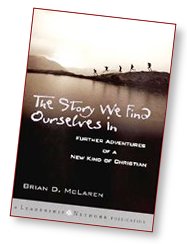
Nature, tortoises and evolution figure prominently in McLaren's new book, “The Story We Find Ourselves In.” It's a sequel to his popular but somewhat controversial “A New Kind of Christian.” Both books are written in an unusual narrative non-fiction style–using fictional characters, rather than sterile discourse, to incarnate theological truths.

Much of “The Story We Find Ourselves In” is set in the Galápagos Islands, the same islands that helped Charles Darwin forge his evolutionary theories. Gigantic tortoises are among the famous wildlife of the islands (galápagos is Spanish for turtle). And the storyline allowed McLaren to indulge his passion for tortoises–10 make their home in his Maryland backyard and winter in his basement.

The central character is once again Neil Edward Oliver (Neo for short), a Jamaican preacher-turned-science teacher whose easy manner and unorthodox views somehow manage to guide Christians and seekers through crises of life and faith.

Neo is the prototype in Brian McLaren's experiment to reimagine evangelism for a post-apologetic world. Neo's latest adventure is likely to stir some controversy as well, because the hero extols evolution as testimony of God's creative imagination.

“Nature is God's artwork, God's text, showing us so much about the Creator,” McLaren told FaithWorks magazine. “I am very respectful of what I can learn from nature.”

Prophetic voice

The author is in fact a teacher-turned-preacher, a former English professor who's now pastor of a non-denominational church outside Washington, D.C. But he's more than a pastor with a knack for writing.

McLaren often is cited as a leading voice of the next generation of evangelicals. And he's a key figure in the “emerging church,” a mostly under-the-radar movement of Christian leaders in their 20s and 30s that is beginning to toss a few waves on the shores of evangelicalism.

In “The Story We Find Ourselves In,” McLaren is not just teaching spiritual object lessons from nature. His goal is much more ambitious. He wants to show that faith and science are not natural enemies, that together they tell the story of God's creative purpose.

“One of our crises, as we enter the postmodern world, is that Christianity has presented itself as a system of belief instead of a story. And we got on adversarial terms with science.”

When science sought to explain the world without God, it produced a story without meaning, McLaren said. And Christians, trying to recast the gospel in the language of science and reason, produced a propositional belief system that lost touch with the story that gave it power.

“I am interested in seeing science and faith as collaborators,” McLaren said.

Nature can teach Christians about diversity and interdependence, said McLaren, who contends both will characterize the future church.

“Life evolves to thrive in many different niches,” and the same should be true among Christians, he said. “We need incredible diversity to fill many, many niches.”

Interdependence, although imbedded in nature, is foreign to the Western individualism so ingrained in American Christianity. That's why McLaren's “new kind of Christian” often uses words like “journey” and “conversation” to describe Christian life beyond the postmodern divide.

Starting a conversation

Conversation implies Christians can learn a lot by interacting with–and listening to–the world, especially non-Christians.

“Their questions are an essential facet of our discipleship,” McLaren said. “They change us.”

“Jesus said we shouldn't worry when people ask us questions; the Spirit will guide us. That says to me there are things we're going to learn when we engage people missionally that we would not learn any other way.”

McLaren and his cohorts emphasize dialogue over debate, community over individualism, experience over proof. They willingly shed the modernist expectation that Christians should have all the answers. Critics accuse them of abandoning all absolutes. But most postmodern Christians don't deny absolutes exist–only that they can be proclaimed unequivocally, without hesitation or humility.

“Certainty is overrated,” McLaren declares. “God calls us to faith and to seek the kingdom.”

There is great danger in the quest to be right, he warns. “History teaches us that a lot of people thought they were certain, and we found out they weren't.”

Likewise, cookie-cutter formulas and go-it-alone strategies will be ill-suited for the church in the new world.

“Our theology and the way we treat people, this to me is really the big issue,” McLaren said. He quotes a fellow staff member who contends their church could trade its contemporary worship style for the Episcopal liturgy and it wouldn't change the character of the church.

“All the things people focus on–style of music and so on–are all much less significant than we realize. One reason we have to pay so much attention to 'cosmetics' is because we are trying to market a message that is very much flawed. We think the gospel is about how to get individual souls into heaven when they die, when for Jesus the message was about the kingdom of God, which is a here-and-now experience, not just a heavenly one, and a communal experience, not just an individual one, and involves all of creation, not just an invisible part of us called our soul.”

Unlikely preacher

Such bold statements can sneak up on the listener, who's easily lulled by McLaren's soft-spoken and winsome manner. The unimposing pastor is not a likely suspect to lead a theological movement, or even to lead a church.

“I'm a total misfit,” he admitted. “I'm a middle-aged bald guy without proper credentials.”

His training is not in theology but in English–a bachelor's and master's from the University of Maryland–and he backed into the pastorate. While in graduate school, McLaren and his wife, Grace, started a Bible study in their home. It attracted mostly graduate students and faculty and in 1982 took the shape of a house church. McLaren led the church while teaching English composition at the university. But as the congregation grew, so did the demands.

“I was either going to have to step back or step in,” he said. In 1986 he left academia to become pastor of the congregation, which became Cedar Ridge Community Church.

Although he never went to seminary, McLaren first bumped up against postmodernism much earlier than most seminary students or pastors.

“In graduate school in the '70s, postmodernism was first hitting the academy through literary criticism. I was exposed to deconstructionism and postmodern thought. I remember thinking, if this kind of thought catches on, Christianity is in real trouble.”

It would be another two decades before the conversation migrated into Christian circles. But for McLaren, the questions raised in those classroom discussions always “simmered on the back burner.”

A new way of thinking

Then he began to detect something different about the young non-believers Cedar Ridge was attracting. “I thought, oh no, that new way of thinking is the way all the people who walk through the doors of our church are thinking.”

He began to re-examine the way he understood the gospel story, particularly the modern, rational formulations and apologetic evangelism he picked up from his Reformed background.

“I went through a real personal theological and faith struggle in the mid-'90s,” he recalled. “I didn't know any other Christians who were struggling with these issues.”

He stumbled upon “Truth Is Stranger than it Used to Be,” by Richard Middleton and Brian Walsh, and later the writings of Leonard Sweet.

“I was so relieved to find at least a few people talking about these things,” he confessed.

Today, McLaren writes “to help get a conversation started” about the Christian faith, he said modestly, but also “to free our understanding of the gospel from these modern categories.”

His earlier book, “A New Kind of Christian,” provoked conversation within the evangelical establishment, not all of it pleasant. Although most reviews were positive, a few were “blistering.” The book was the subject of a four-part analysis in “Books and Culture” last year.

The book questioned Christianity's sometimes clumsy, sometimes costly, accommodation to modern rationalism. Critics said McLaren either offered nothing new or abandoned centuries of essential tradition.

“The people who dislike the book the most tend to be strict, high Calvinists,” McLaren said. That makes sense, he adds, because Calvinism “is the highest expression of modernism.” But he is heartened by the response he receives from other readers, most of whom praise its fresh approach. Some of that affirmation comes from older evangelicals who nonetheless recognize that traditional expressions of the gospel “have turned off their children and grandchildren.”

McLaren seems untroubled that he may not be embraced by the evangelical mainstream. “What I'm really excited about is the next 20-to-30 young leaders who are planting churches, who are in seminary, women as well as men, minorities. They're getting to start so much further along.”

Influence expanding

This “misfit” has quietly earned the respect of the thought leaders, innovative pastors, church starters and entrepreneurs who make up the rag-tag “emerging church” movement. Although McLaren, 46, is older than many in the movement, they usually look to him for leadership. Those young leaders value not only McLaren's insights but the charitable tone he sets for the postmodern conversation.

“Brian has moved beyond simple deconstruction and stone-throwing to a much more productive combination of healthy critique along with future-thinking and praxis,” said Mark Oestreicher of Youth Specialties.

To these younger leaders, McLaren's status gives him credibility. “I wasn't indoctrinated. I wasn't socialized into that. There's a certain perspective you have on the fringe of things,” McLaren said.

Raised among the tiny Plymouth Brethren, shaped by the Jesus Movement, trained in the secular academy, impassioned by art, music, philosophy and nature–McLaren doesn't fit neatly into any evangelical stereotype. But that works to his advantage in an era whose zeitgeist is eclectic, holistic and global.

“I'm not interested in saving evangelicalism or reforming evangelicalism, although others might have that calling. My dream is that there could be a conversation and a friendship among grass-roots leaders and theologians in evangelical, mainline Protestant, Roman Catholic and Orthodox communities, and in some small way that this kind of broad friendship could bring new possibilities to Christian churches around the world.”

“I really see a convergence happening,” he added.

Already McLaren sees evidence that young Christians are more willing to look past doctrinal differences to find fellowship. They see denominations as “structures for connection rather than barriers for isolation.” They are more open to the wisdom and practices of the ancient church and non-evangelical traditions–“resources grossly undervalued in recent decades.”



hesaid_51903

Posted: 5/19/03

He Said/ She Said:
The award

SHE SAID:

“Mrs. Wingfield, this is Denise May at Moss Haven.” That greeting on our home answering machine started my heart pumping. Mrs. May is our assistant principal in charge of discipline. “Oh, no, I thought, who's in trouble? What did one of my sons do?”

All that went through my mind in the split second before the message continued, ” … there's nothing wrong.”

Mrs. May must be used to my previous reactions. She continued, “Garrett wanted to share some good news with you, so if you get this message in the next half hour, please call me back.”

Hmm. She had left the message around 11:30 a.m. and it

ALISON WINGFIELD

was already 2:30 p.m., so I figured it was too late to call and find out what was going on. As I reviewed what was happening that day, I remembered Garrett was going to be in a contest as part of the school district's trip to hear two high school symphonic bands play. He had won the contest for fifth graders at our school, which was a listening game. The students had to guess which instrument they were hearing. Garrett guessed all but one right, so he got to represent our school at this concert.

So, I guessed that Garrett had probably done well in the contest. When I picked him up from school, I coyly asked him why he wanted to talk with me in the middle of the day.

“I won, Mom! Where were you?” he asked. I explained that I was sorry, but I hadn't been home when he called. I was naturally thrilled that he had wanted to share the good news with me. But that bubble quickly burst. I found out the real reason he had asked Mrs. May to call: As part of his reward, he got a free meal from McDonald's. He wanted me to pick it up for him right then.

I was thrilled when I found out he also had won tickets to the Dallas Symphony and a $50 savings bond. He was thrilled with McDonald's french fries. Ah, the simplicity of youth.

HE SAID:

Well, the final truth of the matter explains why when the school secretary called me at work looking for Alison, Garrett wasn't interested in talking to me. I, too, inferred from the conversation that Garrett must have done well in the competition. But I couldn't understand why if the school was calling, he wouldn't get on the line and tell me he had won.

I just thought the school secretary thought I was chopped liver.

Truth is, Garrett was more interested in the Fren

MARK WINGFIELD

ch Fries than anything else.

This is a child, however, who won't eat the hamburgers at McDonald's, won't eat the Chicken McNuggets, won't eat anything except the fries.

At least he knows what he wants–which almost always has been the case. He likes to wear specific colors (orange being his first choice) and do things in specific ways. He wants to eat specific foods and those foods only.

Trouble arises when his idea of what he likes conflicts with generally accepted concepts of good taste. We've had to restrain him at times from going to church decked out in three clashing shades of blue.

“Those colors don't go together,” I'll say.

“They look good to me,” he'll reply.

“But they clash,” I'll shoot back.

“It looks good to me, so that's what's important,” he'll retort.

Chalk one up for courage.

Let's just pray he's able to retain that sense of determination and independence when the peer pressures increase in the years ahead.

News of religion, faith, missions, Bible study and Christian ministry among Texas Baptist churches, in the BGCT, the Southern Baptist Convention ( SBC ) and around the world.


iraq_51903

Posted: 5/19/03

Iraqi Christians fear for safety

By Mark Mueller

Religion News Service

BAGHDAD, Iraq (RNS)–Two weeks ago, Raad Karim Essa arrived home from work to find his furniture on the street. His Muslim landlord wasn't renting to Christians anymore.

Father Adda, an Assyrian Orthodox Christian, prepares for Palm Sunday at his ancient monastery on Mount Maqloub, just outside the northern Iraqi city of Mosul, April 19. The monastery was built in 363 A.D., and its renovation was funded by ousted Iraqi leader Saddam Hussein. Although Iraq under Saddam was primarily a Muslim state, the regime tolerated other religious groups. In post-war Iraq, Christians increasingly express fear that a Shiite Muslim majority will not grant freedom of worship for all. (REUTERS/Nikola Solic Photo)

“He told us not to argue and threatened us,” said Essa, 42, a father of four. “He said the government was no longer here to protect us. What could we do? We feared for our lives.”

"The Muslims want to destroy us," said Amira Nisan, 38, Essa's wife. "I think we were better off under Saddam."

Such a sentiment is voiced increasingly today among Iraq's 800,000 Christians.

Like most of their countrymen, Christians greeted the fall of Iraqi President Saddam Hussein with celebration and hope. But in little more than a month, their desire for greater religious freedom has been replaced by fear of the fundamentalism rippling through Iraq's Shiite Muslim majority, which has moved quickly to exert its influence after decades of violent repression.

Christian women say they've been harassed by Shiite men for walking on the street without head scarves, and priests complain that Shiite clerics inflame religious hatred by calling for the expulsion from Iraq of “non-believers.”

The most overt acts have been directed at Iraq's liquor stores and manufacturers, almost universally run by Christians. The owners of those facilities say they've been threatened with death for selling alcohol, forbidden under a strict interpretation of Islamic law.

"I'm afraid for my people," said Bishop Ishlemon Warduni, the religious leader of Iraq's Chaldean community, which represents about 80 percent of the nation's Christians. The remaining 20

A woman attends mass at Our Lady of the Sacred Heart Church in Baghdad. Some Iraqi Christians fear persecution by Shiite Muslims, who have more freedom to practice their religion since the fall of Saddam Hussein's regime. (Noah Addis/RNS Photo)

percent is comprised mostly of Syrians, Assyrians and Armenians.

“During the war, we were not afraid like we are now,” said Warduni, 60. “All Christians are in danger.”

Warduni recently expressed his concerns in a letter to President Bush, British Prime Minister Tony Blair and U.N. Secretary-General Kofi Annan. On May 13, the bishop was to make his case in a meeting with Jay Garner, the retired U.S. Army general who has been administering Iraq.

“We would like a guarantee of our rights, our freedom and our protection,” Warduni said. “We have a 2,000-year history in Iraq, and that is now threatened. The fanatics would see us gone.”

The worries are most pronounced in southern Iraq, a Shiite stronghold where clerics have issued the most strident calls for the creation of an Islamic republic. Underscoring the dangers, the Christian owners of two liquor stores were shot to death the first week of May in Basra, Iraq's second-largest city, after rebuffing demands to shutter their shops.

But religious tensions are high and rising in Baghdad as well.

See Related Articles:
Charities find donors cool to Iraq aid

Commission urges religious freedom for Iraq

Iraqi Christians appeal for religous freedom

"Ten days ago was better than a week ago, and a week agowas better than today," Warduni said. "I have no doubt that tomorrow will be worse. We're losing what little protection we had."

Under Saddam, Christians were permitted to worship but not to publicly express their views or proselytize. It also was forbidden to give children Christian names.

While those strictures have been swept aside, Christians say they feel even less free in the face of growing Shiite pride and power. In the chaotic days after Baghdad's fall, Shiite clerics sent armed followers to patrol neighborhoods and to safeguard schools and hospitals from looting.

Still under Shiite control, some of those hospitals now bear signs ordering any woman seeking treatment to wear a head scarf.

The relationship between Muslims and Christians has grown more sensitive with the profusion of new mosques. In almost every Baghdad neighborhood, vacant buildings and former government offices have been converted into Shiite houses of worship

The relationship between Muslims and Christians has grown more sensitive with the profusion of new mosques. In almost every Baghdad neighborhood, vacant buildings and former government offices have been converted into Shiite houses of worship.


News of religion, faith, missions, Bible study and Christian ministry among Texas Baptist churches, in the BGCT, the Southern Baptist Convention ( SBC ) and around the world.


hispanic_51903

Posted: 5/19/03

Hispanic School OKs 2008 plans

SAN ANTONIO–Trustees of Hispanic Baptist Theological School approved final preparations to purchase an 82-acre tract across I-35 from the school's current facilities.

Meeting May 6, the board also elected a vice president for advancement, approved the first graduating class with bachelor of arts degrees, approved a strategic plan for 2003-2008 and granted the first sabbatical leave in the school's history.

The property purchase previously was affirmed by the Baptist General Convention of Texas Christian Education Coordinating Board.

Arnie Adkison was named vice president for advancement.
Since 1996, he has been director of the Far West Texas Fellowship of Christian Athletes in El Paso, where he carried primary fund-raising responsibilities.

Adkison has served as pastor of Loma Terrace Baptist Church and Pueblo Nuevo Church in El Paso for 11 years and has served on the student ministry committee of El Paso Baptist Association.

The school's first-ever sabbatical leave was granted to Fermin Flores, who has taught at HBTS for 32 years.

The new strategic plan outlines six focus areas related to governance, institutional advancement, academics, student services, facilities and administration.

The plan builds on previously announced goals to enroll 500 full-time equivalent students by 2008 and build a new student center, learning resource center and other facilities.

Other goals of the strategic plan call for:

Increasing the annual fund to $1 million in contributions by 2006.

Raising $18 million in two capital campaigns by 2008.

Increasing endowment to fund 10 percent of the annual operating budget by 2008.

Hiring an alumni director.

Adding degrees in general studies, leadership, media arts and education.

Developing language programs in Spanish, French and Arabic.

Creating off-campus classrooms in other Texas cities.

Mobilizing all students on annual mission trips.

Establishing a campus child-care center, clinic and counseling center.

News of religion, faith, missions, Bible study and Christian ministry among Texas Baptist churches, in the BGCT, the Southern Baptist Convention ( SBC ) and around the world.


sanangelo_51903

Posted: 5/19/03

Members of Southland Baptist Church in San Angelo dedicate lumber to be used in the Habitat project, part of the church's 25th anniversary celebration.”To have children give $2.50 for a 2 x 4 stud, and then to see that stud become a part of someone's house, that's when missions becomes real.”

San Angelo church builds a mission project in parking lot

By George Henson

Staff Writer

SAN ANGELO–Southland Baptist Church in San Angelo may be setting a record for the shortest distance ever traveled on a mission trip. This mission is taking shape on the church parking lot.

Church volunteers are building a three-bedroom Habitat for Humanity house. But instead of building it on-site, as most Habitat groups do, the San Angelo church is constructing its house on cinder blocks in the parking lot. The house will be moved after completion.

The project has been undertaken in conjunction with celebration of the church's 25th anniversary later this year.

“We wanted to do more than celebrate,” said Dwain Dodson, who is overseeing the construction. “We wanted to do something outside the walls of the church, and the idea of a Habitat house really caught on as a mission project.”

Pastor Bill Shiell concurred the congregation felt that more than a celebration was in order.

“People like to throw birthday parties for themselves, but we wanted to throw one for our community,” he said. “We can in no way repay what has been done for us over the last 25 years, but we wanted to show our appreciation.”

The Habitat house is scheduled to be only the first of 25 mission projects the church does to celebrate its anniversary.

Church leaders decided to erect the house on the parking lot to increase involvement, Dodson said. “Having it here at the church has really stirred up some enthusiasm.”

That enthusiasm hasn't been limited to the church's members alone. After the first day of construction, the local Habitat office said it received more calls than ever before from individuals curious about what was going on and from other groups in the community wanting to know how they could become involved. The church is located on heavily traveled Loop 306.

To raise the $30,000 needed to build the house, church members collected offerings large and small, mainly small.

For publicity, organizers broke down expenses to bite-size pieces, illustrating, for example, that a donation of 28 cents was important because it would pay for one of the 216 joist hangers.

“Building this house is the best thing that I have ever done with a church,” Shiell said. “It's is so hard to get people's hands on missions, but to have children give $2.50 for a 2 x 4 stud, and then to see that stud become a part of someone's house, that's when missions becomes real.”

Children and youth classes took those studs and then drew hearts and crosses and wrote Scripture verses and religious sayings such as “'Jesus loves you' on them.” Some of those were brought forward in an April dedication service in which the presenters and the choir wore yellow hard hats.

“It was quite compelling,” Shiell recalled. “It was really a joyful time.”

The only hard part, Dodson reported, is finding a good place to cut those inscribed boards.

The house will be dedicated and church members will prayerwalk around it and through it Aug. 16. It then will be moved about three miles to its permanent location at a cost estimated to be under $1,500.

Southland members plan to build a second Habitat house in the near future as well. When they do, they hope to partner with another church that doesn't have the funds necessary to build their own house so that the blessing can be shared and a relationship fostered.

News of religion, faith, missions, Bible study and Christian ministry among Texas Baptist churches, in the BGCT, the Southern Baptist Convention ( SBC ) and around the world.


iraqi_commission_51903

Posted: 5/21/03

Commission urges religious freedom in Iraq

WASHINGTON (RNS)–The U.S. Commission on International Religious Freedom has urged President Bush to maintain his commitment to religious freedom for all Iraqis.

“Now that Saddam Hussein has been ousted, the U.S. Commission on International Religious Freedom believes strongly it is essential to ensure that the Iraqi people can exercise their religious freedom in full accordance with international human rights standards,” commission members wrote Bush in a letter dated April 28. “The United States can help this become a reality.”

The commission expressed its concern that U.S. leadership is needed to prevent ethnic and sectarian violence and other human rights violations against Iraq's diverse religious communities.

“The recent murders of Shiite clerics could be the harbinger of further violence within and between religious groups,” they wrote. “Now is the time to prevent such an outcome.”

In a speech Monday in Dearborn, Mich., the president included the issue of religious freedom in his comments about the future of Iraq.

“Whether you're Sunni or Shia or Kurd or Chaldean or Assyrian or Turkoman or Christian or Jew or Muslim–no matter what your faith–freedom is God's gift to every person in every nation,” he said.

News of religion, faith, missions, Bible study and Christian ministry among Texas Baptist churches, in the BGCT, the Southern Baptist Convention ( SBC ) and around the world.


explore_51903

Posted: 5/19/03
LifeWay Explore the Bible Series for June 1

The gospel never should be compromised

Galatians 1:1-12

By Jim Perkins

Madison Hills Baptist Church, San Antonio

We live in an era when our actions and responses are directed quite often by a type of political correctness and cultural sensitivity that results in a canvas painted with a colorless gospel. Not so with the Apostle Paul–his is an uncompromising stance concerning the gospel message that leaves no doubt as to his confidence in salvation through faith in Christ.

Understand the basics

The foundation for the letter to the Galatians is firmly planted on the bedrock of two vital truths. First, the apostleship of Paul arose through a direct commission and assignment from God. His was a calling that came not from man, but literally “by Jesus Christ and God the Father” (1:1). This conviction expressed in verse 1 allowed Paul both to affirm the essential unity between the Father and the Son and to point back to the source of authority for stating his position that salvation is through Christ alone.

Second, Paul left no doubt as to the purpose and effect of Christ's coming. In 1:4, Paul stated Jesus Christ "gave himself for our sins" in order to "rescue us from the present evil age." Our salvation, t

study3

hen, is dependent on what God has done for us in Jesus Christ–the substitutionary death of Christ on the cross that brought forgiveness for sins. That we are dependent on Christ and not our own abilities becomes evident in Paul's choice of the word "rescue." One who must be rescued has no innate ability and harbors no hope that he or she might be able to save themselves.

Reject perversions

Most would say the letter to the Galatians is a type of “pastoral letter” sent from a concerned spiritual mentor (the Apostle Paul) to churches in that region facing crises or needs–and especially here the danger of a compromised gospel. In addition, it becomes obvious that this letter and other Pauline writings also served the wider purpose to ground and instruct the churches in appropriate doctrine and Christian ethics.

The immediate crisis facing the Galatians was the “confusion” produced by those who sought to “pervert the gospel of Christ” by introducing a different gospel that was “no gospel at all” (1:7). Paul considered this insidious perversion of the gospel to be capable of causing the Galatian believers to desert “the one who called you by the grace of Christ” (1:6).

The source of this false and perverted gospel was a specific group, the “some people” of verse 7. Most interpreters posit these people were Judaizers, or people who believed and taught that Gentiles had to have faith in Christ and obey certain tenets of the Jewish law–especially circumcision–to be saved. One might call this perversion of the gospel a “Jesus plus” mentality: Faith in Jesus is good, but there is still more needed to complete or perfect your salvation.

Paul, on the other hand, knew this change in the gospel was not just a compromise capable of promoting inclusiveness. No, this was a perversion of the gospel message that substituted a “different gospel.” Here the word Paul used for “different” in verse 6 probably meant much more than “different so as to be only a subtle variation”; instead, it signified “different so as to be of a whole different kind or category.” Without any reservations, then, Paul insisted this non-gospel must be rejected because it is simply not genuine.

Affirm the source

Paul was extremely careful to explain the source of his preaching concerning the good news of Jesus Christ. This “gospel I preached” was most definitely not a gospel of man's invention, nor was it even the result of the teaching of another apostle (1:11-12). No, what Paul taught was nothing less than the truth revealed to him by our Lord and Savior, Jesus Christ.

This begs the question, however, as to exactly when Jesus Christ revealed this gospel message to Paul. Most interpreters agree in pointing back to the Damascus road experience as the life-changing, formative occasion in Paul's Christian experience (read Acts 9). It was during Paul's trip to that city–a trip undertaken to expand the persecution of Christians–that Jesus revealed himself and the basic content of the gospel message.

This is not to say that Paul abstained totally from any conversation with the other apostles, or believers such as Ananias or Barnabas. It does mean, though, that the interpretation or significance of the facts related to the gospel came from Jesus Christ alone.

Questions for discussion

bluebull Do you believe the temptation or pressure to compromise the gospel message still exists today? In what form is pressure most likely to be experienced?

bluebull Draw up a “general guiding principle” you could apply to your experiences of sharing the good news of Jesus Christ with others. Look to Galatians 1:8-10 and 1 Peter 3:15 for guidance.

News of religion, faith, missions, Bible study and Christian ministry among Texas Baptist churches, in the BGCT, the Southern Baptist Convention ( SBC ) and around the world.


iraqi_charities_51903

Posted: 5/21/03

Charitiees find donors cool to Iraq aid

By Mark O'Keefe

Religion News Service

WASHINGTON (RNS)–Charities ramping up U.S. campaigns to benefit war-torn Iraq are finding the early fund-raising climate much cooler than the 100-degree temperatures troops faced in the desert.

The reason? Many potential donors haven't yet perceived a compelling need.

“Iraq has not resonated with the American public as an object of private philanthropy,” said Richard Walden, president of Operation USA, a Los Angeles-based relief group. “If we could put the solution in a bottle, we would.”

Experts offer a variety of explanations for the sluggish start:

The war hasn't caused the full-blown humanitarian crisis many had expected. The United Nations, for example, had predicted up to 1.5 million Iraqi refugees would flee for neighboring countries. Dozens of charities have been at the borders, waiting with help, but only a handful of refugees have come.

Journalists fixated for weeks on battlefield news are just beginning to tell the heart-wrenching people stories that motivate donors.

Many charities, unable to enter the country during the war, are only now assessing Iraqi problems, much less prescribing specific solutions that some donors–especially large ones–require before giving generously.

Some Americans figure that whatever problems do emerge are the responsibility of their government, which has already committed billions of dollars for relief and reconstruction.

But the $2.5 billion approved by Congress “is just a drop in the bucket when you look at the needs of Iraq,” said Bathsheba Crocker, co-director of a project on postwar Iraq at the Washington-based Center for Strategic and International Studies.

Charities play an indispensable role, helping people in ways government cannot, especially in this early stage of recovery when many Iraqis lack safe water and competent medical care, Crocker said.

Still, it's a tough sell.

Mercy Corps hopes to raise $2 million for Iraq in two months. In 21 days, it raised slightly more than $280,000–despite a radio and television advertising blitz, the latter on Al-Jazeera in an attempt to capture the attention of Arab and Muslim Americans.

The group's 1999 efforts for war-torn Kosovo, by comparison, garnered $1.6 million in the first 21 days.

A big difference between the two is the media, officials believe. In Kosovo, television showed thousands of refugees leaving their homes in fear. In Iraq, the main problem has been people staying in their homes without suitable water–a far less compelling story.

“Unfortunately, the images folks are seeing on the TV lately are of Iraqis looting their country, which is not likely to prompt people to dig deeply into their pockets,” said James Bishop, director of humanitarian response for InterAction, an alliance of 160 international relief and development groups based in the United States.

Some charities simply say the right time for major fundraising has not arrived.

Atlanta-based CARE already is working in Baghdad, restoring electricity, for example, to the 1,200-bed Al Yarmuk General Hospital, which was shelled during the war. But CARE has decided to create a detailed assessment of Iraqis' problems and the charity's solutions before making its pitch.

“We could go out and be very vague right now and say CARE will respond, just give to help Iraq,” said Brian Cowart, CARE's director of direct marketing. “But our donors expect us to be more specific.”

News of religion, faith, missions, Bible study and Christian ministry among Texas Baptist churches, in the BGCT, the Southern Baptist Convention ( SBC ) and around the world.