tidbits_60203

Posted: 5/30/03

Texas Tidbits

DBU wins baseball title. In its first appearance in the National Christian College Athletic Association National Championship, Dallas Baptist University claimed the title May 17 with a 4-3 win over top-seeded Spring Arbor University. DBU entered the final round in Celina, Ohio, as the only undefeated team.

Noble Hurley stands with DBU President Gary Cook in front of the sign marking the name of the new apartment building.

bluebull Hurley Hall named. Dallas Baptist University has dedicated one of its new Colonial Village apartment buildings in honor of Noble Hurley and his late wife, Jane. He is a longtime supporter of the school and currently serves as a trustee. He is a member of Gaston Oaks Baptist Church in Dallas and worked 32 years as president of Noble Hurley Brick Co. He also served 20 years as chairman of Swiss Avenue Bank.

bluebull Ball receives Baylor honor. Virginia Beall Ball of Indiana received an honorary doctor of humane letters degree from Baylor University May 17. The 1940 Baylor graduate endowed the Beall-Russell Lecture Series and the Beall Poetry Festival, in addition to other contributions to the university.

bluebull Baylor alumni honor Olson. The Baylor University Alumni Association presented its Price Daniel Distinguished Public Service Award May 17 to Lyndon Olson Jr. of Waco. He is a 1969 Baylor Law School graduate and a former member of the Texas House of Representatives. Currently, he is senior adviser to Citigroup in New York City.

News of religion, faith, missions, Bible study and Christian ministry among Texas Baptist churches, in the BGCT, the Southern Baptist Convention ( SBC ) and around the world.


teens_60203

Posted: 5/30/03

Religious teens have stronger family ties

CHAPEL HILL, N.C. (RNS) –Teens who are members of religiously involved families are likely to have stronger family relationships than teens in families that are not religiously active, a new report shows.

The findings come from a report by the National Study of Youth and Religion, a four-year research project based at the University of North Carolina at Chapel Hill.

“All three dimensions of family and parental religious involvement analyzed here (family religious activity, parental religious service attendance and parental prayer) tend to be associated significantly with positive family relationship characteristics,” reads the executive summary of the report.

The findings are published in “Family Religious Involvement and the Quality of Family Relationships for Early Adolescents.”

Looking specifically at youth ages 12 to 14, the report found those in families heavily involved in religious activities are more likely to have strong relationships with their parents and participate in family activities and less likely to run away from home.

Eleven percent of youth fit into this category, where religious activity such as attending church, praying or reading Scriptures together takes place five or more days a week. In comparison, 36 percent of youth are part of families that do not engage in religious activities.

The findings are based on analysis of data from the 1997 National Longitudinal Survey of Youth that involved almost 9,000 students. The project that produced the study is funded by Lilly Endowment.

News of religion, faith, missions, Bible study and Christian ministry among Texas Baptist churches, in the BGCT, the Southern Baptist Convention ( SBC ) and around the world.


tbm_iraq_60103

Posted: 5/30/03

Texas Baptist Men ship 600
boxes of food donated for Iraqi people

By John Hall

Texas Baptist Communications

DALLAS–Texas Baptist Men has shipped about 600 food boxes donated by Texas churches to Iraq to help with relief efforts.

The cause brought Baptists together to provide boxes that will feed a family of five for a month. Churches in the Austin, Burnet-Llano and Tarrant Baptist associations collected large numbers of boxes. Local churches brought food from Waco, Plains, Gatesville, Dallas and Corsicana.

The Baptist Student Ministry at East Texas Baptist University also pitched in.

Rodney Gant of First Baptist Church in Plano applies to the food boxes stickers that read John 1:17 in Arabic. Texas Baptist Men coordinated shipping the food boxes as part of a national effort by the SBC International Mission Board.

Cooperation between various Baptist groups within the Austin Baptist Association was particularly impressive, according to Associate Director of Missions Randy Newberry. The association collected more than 150 food boxes.

“The exciting thing is seeing the people get excited and keep bringing things,” he said. “This is the kingdom ministering in the name of Jesus.”

Bill Mauldin, a Texas Baptist Men volunteer from Northwest Baptist Church in Austin, said the food drive helped his church be “part of God's kingdom” by “fulfilling God's command to take care of people.”

The boxes, labeled with John 1:17 in Arabic, offer a message of hope and love, he said.

Mission workers in Iraq will determine which families have the most need for the food, and volunteers will take the food to them. While the workers have not been chosen, there's about a 90 percent chance Texas Baptist Men will be present when the distribution time comes, said Cotton Bridges, a vice president for the men's mission movement.

Volunteers will bring the food to the families with a message similar to “God has been good to us, and he's sent some food to you,” according to Bridges, who has delivered relief supplies before. Workers most likely will ask if they can pray for the family, a request Bridges never has seen rejected.

News of religion, faith, missions, Bible study and Christian ministry among Texas Baptist churches, in the BGCT, the Southern Baptist Convention ( SBC ) and around the world.


steeples_60203

Posted: 5/30/03

More steeples doing double duty

NEW YORK (RNS)–About 1 percent of all cell phone towers in the United States are housed in church steeples, according to the New York Times.

Cell phone companies that have looked to expand their coverage areas often pay churches between $1,000 and $3,000 a month to rent space in church steeples, said Jim Fryer, a cell phone analyst in Landsdown, Pa.

The steeples provide the height needed to transmit signals and often receive the blessing of urban planners who do not want transmission towers cluttering the skyline.

“When churches were originally built, they wanted them to be the tallest structure in the area–the closest to heaven, or so people could hear the bells,” he told the Times.

Fryer predicted more churches would rent their steeples to cell phone companies as the country's 100,000 towers are expected to triple within the next five years.

In Ipswich, Mass., the landmark steeple on the historic United Methodist Church was destroyed by a lightning strike in 1973. In 1996, under an agreement signed with Bell Atlantic, the steeple was rebuilt, and a cell phone tower was installed.

Still, the phone company brought in a consultant to convince the congregation that they “wouldn't glow on Sunday morning” from radiation, said the church pastor, Bob Ebersole.

Ebersole was unconcerned about sordid conversations that might be relayed through the transmitter in the steeple.

“We don't require a statement of faith from the person that empties our dumpster,” he told the Times.

More churches are projected to rent their steeples to cell phone companies as the country's 100,000 towers triple within the next five years.

News of religion, faith, missions, Bible study and Christian ministry among Texas Baptist churches, in the BGCT, the Southern Baptist Convention ( SBC ) and around the world.


south_africa_60203

Posted: 5/30/03

Song played role in South Africa

NEW YORK (RNS)–Did music help end apartheid in South Africa, a nation where long ago song, spirit and faith merged into one?

Yes, argues a new documentary that chronicles the role that song–inseparable from religious faith–played in the four-decade struggle to overthrow white minority rule in South Africa.

“Amandla: A Revolution in Four-Part Harmony” communicates what New York Times critic Elvis Mitchell calls music's “subversive power.”

The documentary focuses in part on the music of Vuyisile Mini, a singer and composer executed in 1964 for his political activism.

Mini's acclaimed black freedom songs were remarkable for their haunting melodies and expressive power–so much so that even whites liked them. But few whites knew that one of Mini's catchy tunes was actually a song called “Beware Verwoerd”–an anthem in Xhosa warning Hendrik Verwoerd, the hated architect of apartheid, he faced a day of judgment.

Deep wells of religious tradition, symbolism and feeling were imbedded in the songs–a world of music and verse, memory and hope in which Nelson Mandela became Moses, the Walls of Jericho were more than a mere symbol and Jesus was a black liberator.

“Jesus was a big player in the freedom song scene,” said director Lee Hirsch. “'Jehovah will free us;' 'The liberation will come through Jesus, through Mandela;' 'Jesus will look after our boys in exile and comfort our mothers.' These were all common themes.”

With its profiles of musicians, singers and “freedom fighters,” scenes of singing and classic archival footage of leading figures, “Amandla” received acclaim at Sundance Film Festival and now has been released in New York and other major U.S. cities.

The central question the film poses is this: Did the struggle for black majority rule lead to song or did song lead to struggle?

One answer is that song and struggle could not be separated. Music itself became spirit, a life force, even redemption.

One reason music proved to have such redemptive power was because apartheid–the rigid system of racial segregation imposed in 1948 by a white minority government–proved so dehumanizing.

To overcome apartheid's dispiriting effects, solidarity was found in church.

As with many African-American congregations, the power of collective song and “letting the spirit rise” is central to the South African church experience.

That draws parallels to the experience of blacks in the American South fighting oppression.

“There has been clear cross-pollination,” Hirsch said.

News of religion, faith, missions, Bible study and Christian ministry among Texas Baptist churches, in the BGCT, the Southern Baptist Convention ( SBC ) and around the world.


secularists_60203

Posted: 5/30/03

Gallup explores identifiers for nation's 'secularists'

PRINCETON, N.J. (RNS)–The 10 percent of Americans who claim no religion tend to be young, liberal and live on the West Coast, according to research by the Gallup Organization.

The so-called “secularists,” while “being detached from the religious process also are apparently more likely to be detached from other American institutions such as marriage and the political process,” Gallup researchers said.

While 69 percent of secularists are registered to vote, that figure is smaller than the 83 percent registered among Americans who claim a religious preference. The percentage of secularists who are unmarried and living with a partner–12 percent–is double that for religious Americans.

Secularists also are younger–those between the ages of 18 and 29 are four times as likely as those older than 65 to be secularists, and twice as likely as those between the ages of 50 and 64.

The Western United States–particularly Oregon and California–has a larger percentage of residents identifying as secularists (15 percent) than other parts of the country (typically less than 10 percent).

Forty-three percent of secularists describe themselves as moderate, while 35 percent are considered liberal and 20 percent are conservative. Other Gallup polls have shown that more religious people tend to be more conservative.

Only about 1 percent of Americans describe themselves as atheists, who have no belief in God, or agnostics, who aren't sure about the existence of God, according to the Gallup study.

News of religion, faith, missions, Bible study and Christian ministry among Texas Baptist churches, in the BGCT, the Southern Baptist Convention ( SBC ) and around the world.


scouts_60203

Posted: 5/30/03

Baptists, Scouts pitch tents together 50 years

By Bob Carey

Baptist Press

RIDGECREST, N.C. (BP)–Southern Baptists and the Boy Scouts of America have worked through the Association of Baptists for Scouting for almost 50 years, so it was a reunion of sorts when more than 120 Scout leaders from 12 states and various Baptist denominations met this spring at LifeWay's Ridgecrest Conference Center.

The conference, titled “God and Country,” highlighted ways Baptists can positively influence America's youth from elementary to high school through Cub Scout packs and Boy Scout troops.

The weekend brought pastors and scout leaders together to find ways for local churches to encourage the growth of Boy Scout troops. Several pastors committed to add either Boy Scout troops or Venturing programs in their churches. Venturing is a coeducational program for youth between the ages of 14 and 20.

Currently, about 5,000 of the nation's 90,000 Baptist congregations (SBC and non-SBC) sponsor Scouting programs, according to Don York, director of the relationships division of the Boy Scouts of America. Many more Baptist families are involved in Scouting through packs and troops sponsored by local schools or other churches.

Several speakers discussed the outreach possibilities Scouting offers churches. Chip Turner, vice president of FamilyNet in Fort Worth, noted Scouting and Baptist churches have a long history together.

“Dr. George Truett of First Baptist, Dallas, endorsed the concept of Scouting in churches in 1924, but we still have a lot to do to reach more youth,” Turner said.

David Hansley, president of the Association of Baptists for Scouting, encouraged the crowd to help pastors and youth ministers see the benefits of Scouting. “Most pastors, when they see the benefits of Scouting, will catch the vision. There are too many boys to reach. It's a great outreach if the churches will just take it and run.”

Retired Navy Commander Robert Fant Jr., a former Vietnam POW, testified to the importance of both church and Scouting in his life.

“When I was captured, the first thing I concentrated on was the Lord's Prayer, then the 23rd Psalm. Soon after that, I began concentrating on the Scout Law. It was these things I had learned at church and in Scouting that helped keep me going.”

In addition to the general sessions and specialized training, the conference also featured two banquets to honor recipients of the Good Shepherd Cross and Staff award. The award is a national recognition for adults who render outstanding service to Baptist youth through their churches and the Boy Scouts of America. The award is given to either laypeople or pastors who lead in the spiritual, physical, mental and moral development of youth.

This year, 22 recipients were recognized for service to Baptist Scouting, with six of the recipients receiving Silver Good Shepherd awards representing at least 50 years of Scouting involvement. They join several prominent Baptists who are former recipients of the award–LifeWay Christian Resources President Jimmy Draper, SBC Executive Committee President Morris Chapman, evangelist Billy Graham, former U.S. President Jimmy Carter and Sen. Trent Lott. Texas author and motivational speaker Zig Ziglar is slated to receive the honor later this year.

News of religion, faith, missions, Bible study and Christian ministry among Texas Baptist churches, in the BGCT, the Southern Baptist Convention ( SBC ) and around the world.


sanmarcos_60203

Posted: 5/30/03

Hand-stenciled signs on a campus telephone pole honor graduating seniors at San Marcos Baptist Academy. Arman Rupani of Flower Mound (right) conducts an experiment in a science lab.

San Marcos Academy takes students full-speed ahead

By Craig Bird

Special to the Standard

SAN MARCOS–At first glance, the signs don't seem to share anything except proximity.

The standard-issue, permanent “Speed Limit 35” notice sits a few yards inside the entrance. Close behind it, nailed to a telephone pole are individual, temporary, hand-stenciled boards: Class of '03, Renee, Justine, Collins, Reed, Kristina, Dale, Anjuli, Claudia T., Bev, Cody and Tory. Along the road, other telephone poles sprout from the ground bearing more names–and other traffic restrictions.

Senior Brady Mitchell says the academy has helped her fulfill her dream of attending Baylor University.

Separately, the signs' messages are clear. But together they provide symbolic bookends to the ongoing story of San Marcos Baptist Academy, one of the few military boarding schools in Texas and one of the lesser-known ministries of the Baptist General Convention of Texas.

Texas Baptists support the academy through gifts to the BGCT Cooperative Program.

Make no mistake: The Academy, with a coed enrollment of about 250, is a place of structure and rules, of responsibility and accountability. Each student is graded and ranked weekly on a two-tiered system that considers both academic standing and behavior. Privileges are directly related to the scores.

The tightly run program is geared to help students recognize and reach their potential intellectually, physically and spiritually.

“We celebrate the fact that 97 percent of our graduates go on to attend college. That is an enviable academic achievement,” said President Victor Schmidt. “But more importantly, we also strive to prepare our students for life by surrounding them with a community fully committed to values based on Jesus Christ. This is a mission field, and Texas Baptist are helping change lives.”

Lives like Jorge Ayala and Brady Mitchell, Claudia Tijerina and Ryan Gaspard and Anjuli Kamins. All names on those telephone poles.

Returning students Ashley Dunn of Gainesville, Claudia Diaz of Sugar Land and Danielle Madsen of Richmond celebrated the start of school last fall.

Ayala, a 17-year-old junior, is a newcomer, arriving at the school last January, the most recent stop on a traumatic, four-year tour of boarding schools and rebellion. He thinks this will be his final stop.

“When I was about 13, I started fighting with my dad all the time,” he explained. “My parents sent me to several of the best boarding schools in Mexico, and even to Canada for a year, but I just didn't have the strength on my own to be self-disciplined. I wound up partying all the time.”

Finally, a family friend who lives in Houston suggested San Marcos Academy. There, Ayala has found the academic attention and structure he was looking for–and a faith experience he had not expected.

“I went to church in Mexico sometimes, but it didn't mean anything,” he said. “Here, I feel the presence of God with me. Mr. (Craig) Paul (the campus pastor) really supported me and answered my questions, and my roommate showed me how to live a Christian life. I was saved two months after I got here. My parents are really impressed.

“I've learned the Bible can help me make good decisions. This summer, I'll go home for two months. It will be my last chance to prove that I've really changed.”

Mitchell grew up in the Dallas area with two dreams–to go to boarding school and to attend Baylor University. Doing the first made the second possible.

“In the seventh grade, I got this idea I wanted to go to boarding school, and my parents said I could for my ninth grade,” she said. “Then when I got here, I cried and cried and cried, I was so homesick. But my parents made me stick it out. And I'm really glad. The past three years have been great, with so much to do and so many friends.

Senior members of the Reserve Officer Training Corps celebrated the end of the year by wearing civilian clothes to morning assembly.

“Plus my grades are high enough I was accepted by Baylor,” Mitchell continued. “It's almost impossible to fail here academically–not because it's easy. It's very hard, but the teachers here are all overqualified for what they teach. Plus, in addition to mandatory tutorials if your grades aren't good enough, the teachers come out here on their own time in the evenings and weekends to give you as much help as you need. They refuse to let us not learn.”

Tijerina, among the 20 percent of students who do not live on campus, was drawn by the international outlook of both the classroom and the student body. The academy draws students from Asian countries as well as South and Central America, Mexico and the Middle East.

Previously, “school just wasn't very academically challenging, and we weren't exposed to world issues,” she explained. “The teachers here not only do a great job teaching, but they show you how to apply what you've learned. And all the students from other countries really enrich the intellectual mix.”

The worldwide outlook will be valuable, Tijerina believes, not only when she moves on to Baylor but as she answers a call to full-time Christian vocation.

“I went to Germany last summer on a mission trip, and I'm going back there again this summer,” she said. “I think that may be where God wants me as a career missionary.”

There would seem to be a logical connection between Gaspard's profession of faith in Christ at summer church camp and his enrollment at the academy in the fall. But there wasn't.

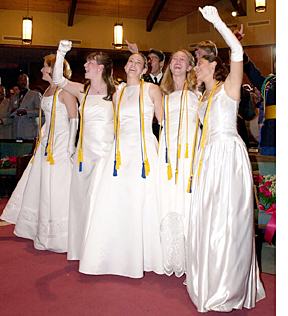
2002 seniors Sophia Troxell of Wimberley and Mary Claire Ledoux, Lindsey Burnett, Sarah Dillon and Nicole McClusky of San Marcos celebrated commencement.

“I had mono my sophomore year (in Rockwall) and got way behind in school,” he explained. “My aunt was surfing the Internet when she found this school. We had never heard of it. I came here for a better academic opportunity. If I hadn't, I don't think I would have gotten into college.”

Gaspard is headed to Texas A&M-Commerce with hopes of transferring to Texas A&M-College Station later.

His new faith commitment led him to apply for the chaplain's slot in his ROTC corps. “I didn't know what I was getting into,” he admitted. “We have Buddhists and Muslims in the corps, and it was hard to overcome some of the barriers. But it helped me learn what I really believe and why I believe it.”

Now he plans to join the military, aiming to be an airborne chaplain.

An American couple's conversion to Hinduism led, indirectly, to Kamins' enrollment at the academy.

“My parents came to India as part of their process in becoming Hindus,” she said. “They adopted me when I was a few months old and brought me back to Seattle.”

The family moved to Austin four years ago, but the young teenager was figuring out she needed both intensive academics and firm structure. She got the first at a private day school, “but I couldn't handle all the freedom my parents gave me,” she said.

She looked in the yellow pages for a boarding school and found the academy. It has proved all she hoped for–and more.

“I love crowds, and it is great to always have a group of girls to talk to at the dorm,” she explained. “The teachers pushed me hard but helped me every step of the way.”

She also started paying attention to what was said in chapel and how the teachers and staff and many of the students lived up to the devotions.

“There were Christians all around me, and I found I enjoyed that environment,” she said. “I started to ask, 'Why the difference?' Eventually I realized Christianity is world-embracing rather than self-serving. I wanted to live like that.

“My dad is OK with it (being a Christian), if it's what I want. But my stepmother thinks I'm just going through a phase. But this is real. I am a Christian.”

The 30-member staff at San Marcos Academy is remarkable not only for devotion but also for longevity. Two teachers are 35-year veterans, and two others have passed the 25-year mark. Many staff are former students or the children of former students or staff.

“I have no doubt that all our people are here because they are called to this ministry,” Schmidt insisted. “None of them are paid what they are worth, but they love these kids so deeply and do a magnificent job.”

The staff agrees.

Byron Robinson, one of the 35-yearers, has a Ph.D. in reading and turned down a faculty position at the University of Mississippi to stay at San Marcos and teach English and math. He also coached the offensive line on the football team and coached track for 27 years until health problems made him drop that two years ago.

“This is a special place,” he said. “It allows us to establish close relationships with both the students and their parents. I hope my granddaughter gets to go to school here.”

The San Marcos Baptist Academy senior class of 2003 celebrated homecoming with a bonfire. Jorge Ayala says the academy changed his life.

News of religion, faith, missions, Bible study and Christian ministry among Texas Baptist churches, in the BGCT, the Southern Baptist Convention ( SBC ) and around the world.


richardson_60203

Posted: 5/30/03

Young and old harmonize on Richardson ministry

By George Henson

Staff Writer

RICHARDSON–Youth and senior adults joined hands at First Baptist Church of Richardson on a recent weekend to work in 15 area homes.

More than 120 members of the junior high and senior adult choirs cooperated with four Sunday School departments to assist widows, the disabled and families of men deployed for military service with work around their houses.

Alexandria Evans cleans a window in the home of church member who needed a helping hand this spring. She was among 120 youth and senior adults from First Baptist Church of Richardson participating in Fix-Sings, a combination missions and music effort.

The project, called “Fix-Sings,” concluded with a hotdog dinner and concert at the church. Workers young and old who participated invited residents of the homes where they had worked to join them for the evening.

Unlike many church home-repair mission projects, this one did not target the poor but rather church members with special needs.

For example, the volunteers aided the family of man deployed by the military.

“The lady in that house was so appreciative of our help. We trimmed trees and took care of the lawn, so now when her husband comes home he can spend time with his family instead of taking care of those sort of things,” said Gerald Ware, associate minister of music and minister to senior adults.

Young adult Sunday School members took care of work on ladders outside while the junior high students and senior adult choir members worked indoors.

The project was both helpful and insightful, Ware said.

“It opens the eyes of kids to ministry. Often we send kids out of state to do ministry, but here they saw that ministry opportunities are right in their own backyards. And when we asked them what they thought at the end of the day, almost every one said, 'It was fun.'”

The day also helped foster intergenerational relationships, he said. The Goldenaires, the senior adult choir, adopts high school choir members for each choir mission trip, so that they can pray for them daily. On this project, they established links with younger youth.

Keith McCormick ( above) takes the high road while James Coker takes the low road on an outdoor cleaning project. At right, workers cover both sides of a large window

News of religion, faith, missions, Bible study and Christian ministry among Texas Baptist churches, in the BGCT, the Southern Baptist Convention ( SBC ) and around the world.


foreman_60203

Posted: 5/30/03

GEORGE FOREMAN:
Heaven-bound heavyweight

George Foreman, two-time former heavyweight boxing champion and globally renowned corporate spokesman, is also an ordained minister and founder of the George Foreman Youth and Community Center in Houston.

Q:

In your book, you talk about your childhood–how you were raised in extreme poverty and had to learn everything the hard way. What was it like for you growing up?

I was raised in a one-parent home, and my mother had to work two jobs. When you're in a single-parent home, they try to give you a good foundation, but by the time you're 4 or 5 years old, from that point on you're pretty much on your own. You get your hand burned, and you learn not to put your hand on the fire. So everything I learned I had to learn the hard way. There are seven of us total, I'm number five of seven kids, four boys and three girls. Most of my childhood I was raised in the city of Houston, where I am now. But I started my boxing career in California.

Q:

How did you get started in boxing? What motivated you?

After I dropped out of junior high school, I heard a commercial–a great football player by the name of Jim Brown said if you're looking for a second chance, join the Job Corps. And I was looking for a second chance–I was in big trouble anyway–and I joined. That's where I started a basic education and vocational program. I studied electronic assemblies in the Job Corps.

One day there was a fight being broadcast between Muhammad (Ali)–he was Cassius Clay then–and he was fighting Floyd Patterson. All the kids said, “George, you're a bully; why don't you be a boxer?” And I just took the challenge. I said, “OK, I'll show you.” Just to prove it for myself, I went out for boxing.

I didn't like it; I really didn't like it. But the boxing coach, Doc Broadus, liked me. He said, “Look, if you stop fighting in the streets and the alleys, you could be an Olympic champion.” I had no idea what an Olympic champion was. He stayed on my back, and I went back to California to work for the Job Corps center, and I learned how to box. In 1968, I became a gold medalist in Mexico City.

That was the highlight of my whole athletic career. I was a 19-year-old boy who had never had a dream come true before, and there I am standing on the platform with the medal around my neck, and I hear the national anthem in the background–there's never been anything like that in my life since.

Q:

You've been through a lot of ups and downs in your boxing career. What effect did losing have on you? Was it as important as winning?

In 1973, I became heavyweight champion of the world with 38 victories, no defeats as a professional. You get to a point where you think you cannot lose. I felt like I had the greatest power with my fists, I was the strongest man in the world. I kept winning fights, but then I lost to Ali in Zaire, Africa.

It devastated me. It really did have a great effect on me. I told everybody I was going to be heavyweight champion of the world forever, and I was the strongest man alive. And I lost in Zaire. In 10 seconds, my whole life was changed. One day people walking by you were afraid to even ask you a question, and the next day they're patting you on the back with pity. That was devastating. It changed my life.

Q:

But you regained the heavyweight championship.

Twenty years after I lost. I was 45–the oldest ever to do so.

Nobody believed it. They said, “George Foreman is gonna get himself hurt; he's too old.” I heard it all. But one thing I always had going for me, I knew how to box, I always knew how to box. I gave it up to become a preacher, but not because I couldn't do it anymore. Just that the higher calling penetrated my life.

Q:

You're talking about the religious awakening you had in 1977?

I didn't believe in religion, but I knew there was a God somewhere.

Everybody I knew who was in (religion) always seemed like they were running from something. So I wasn't going to take it up. But that night in Puerto Rico, I had my last boxing match in 1977 with Jimmy Young. I lost a decision, a split decision, went back to my dressing room to cool off, and that's when it all started happening.

I started thinking, I could go home and retire, I got money, I could retire right now to my ranch and die. And before I knew it, that had taken over my whole conversation–you're gonna die. I realized I was going to die in that dressing room from a boxing match.

I thought silently, because I thought if I revealed to anyone in the room what I was thinking that they was gonna figure I was depressed because I lost the decision. So I kept it in. And right within my thoughts I heard a voice within me that said: “You believe in God. Why are you scared to die?” And I was scared; … I didn't want to die. I mean, I didn't think that could happen to me so I started jumping up and down, saying: “I'm not gonna die; I got everything to live for.”

I tried to make a deal with the voice–I'm champion of the world, I'm George Foreman, I can still give money to charity and cancer. I heard an answer right in my thoughts: “I don't want your money. I want you.” And that's when I knew I was about to die.

I said, “God, I believe in you, but not enough.” When I said that, there was a deep dark nothing over my head, under me, all around me was just a dump yard of every sad thought I ever had in my life, multiplied like nothing. And I was dead, and I could smell death, and it was just the most horrible thing. It was like someone dropped me off in the deep sea–no help–there was no way I could get out of this.

And I said, as a tough man, I've always been tough, I said, “I don't care if this is death, I still believe there's a God.” When I said that, a gigantic hand snatched me out of this “nothing,” and I was lying in the dressing room bleeding, blood flowing through my veins. And evidently they had picked me up off the floor in the dressing room and laid me on the table, because that's where I was and everybody was standing around me crying, and I said to my doctor: “Move your hands. The thorns on his head are making him bleed.”

I saw blood coming down my forehead, and I hadn't been hit in the boxing match. And I told my masseur, Mr. Fuller, “You move your hand because he's bleeding and they crucified him.” And I started screaming words I never screamed before–that Jesus Christ was coming alive in me. And I jumped in the shower, started screaming, “Hallelujah, I'm clean, I'm born again, I'm going out to save the world!” and they said, “You better put on some clothes first.”

I tried to explain it away as much as I could–you got hit too hard, you're hot, I didn't believe in religion, Jesus, I never even thought it existed.

Q:

You were running away from it?

Religion was for depressed people, just an excuse if you didn't have anything else. So here I was embarrassed because my friends, we made fun of religion.

After that experience, I was still a top contender, but I just couldn't go back into the gym. I didn't know what to do with my life. And I started telling this story … and people started calling me “brother” and I was ordained at the Church of Lord Jesus Christ in Houston at the end of 1978 as an evangelist. I started traveling to hospitals and prisons and telling this story. Eventually, I started preaching weddings and funerals. That's been the story of my life. I never intended to be a preacher, never!

I started a youth center, my brother-in-law and I, in Houston, for the kids to hang out. Finally I was broke, I would have to close the youth center if I didn't quickly move. The only way I knew how to make money and not to beg people for it was to be a boxer again. It hurt me to take my shirt off again and be a boxer but it was the only profession I had. And that's why I went back.

Q:

Was it hard for you, believing in Christianity, which emphasizes peace, to take up boxing, with all the violence that's involved?

That was a hard thing for me. When I started the youth center, some parents wanted me to get their kid interested in boxing. I said: “Look, I'm a preacher. I'm not going to be helping boxers; that's nothing but ignorance and violence.” And then one day I inquired about the kid, and (learned) he robbed a store in my neighborhood. The storekeeper shot his friend, and he shot the storekeeper. All these lives were devastated because I didn't want to look like a backslider. I said, “I can't help this kid, but I'll never let another get away from me.”

Q:

What do you pray for?

You know this peace I found in 1977? More than anything, I pray to keep it. When I was about to die in that dressing room, all I could think of was I didn't say goodbye to my mother, I hadn't gotten a chance to embrace my kids, there were friends I forgot to say I'm sorry to. I had a second chance to live, and I'm constantly embracing my loved ones. My friends know that they're my friends–even my enemies know that they're my friends. All I pray is to be consistently like this all the days of my life.

I never pray for things–just to consistently be the same way I am. I never get upset about what I read in the newspaper. I realize that every human being can make a difference in this world. Just make certain that I'm consistently making a difference.

Q:

What's your relationship like with Ali?

We've become great friends. Muhammad Ali and I–I love him like a little brother. I'm always talking the Bible to him and he's saying, “Uh-oh, here he comes!”

Q:

Does Ali ever come back and quote the Koran to you?

Never, never. It's always like, “George, if God wants me to know about it, he'll tell me; don't do it, George, don't!” That kind of thing.

Q:

Is there any minister that you admire as a role model?

There are so many guys who do so many good things. I hate to say just ministers. There are so many people out there who do so many good things. Dr. Robert Schuller, I told him what happened to me … I said, “I know you may think I'm crazy but I'm telling you I was dead.” He said, “George–I'm a reverend and I'm a psychologist, and I believe you.” I've never forgotten that.

That was all I needed. From then I started running. I thanked him in my book for being a good corner man–to push you off the stool when you don't want to go on. In the ring sometimes when a guy is whipping you bad, you sit on your stool and you say to your corner man, “I think I had enough.” And it takes a strong trainer to pick you up and say, “Get back out there; don't you quit!”

Interview by Wendy Schuman of Beliefnet. Distributed by Religion News Service.

News of religion, faith, missions, Bible study and Christian ministry among Texas Baptist churches, in the BGCT, the Southern Baptist Convention ( SBC ) and around the world.


gay_sbc_60203

Posted: 5/30/03

Gay-right protestors target SBC again

By Bob Allen

EthicsDaily.com

For the fourth consecutive year, homosexual-rights activists are organizing a presence at the Southern Baptist Convention to protest anti-homosexuality rhetoric by the convention.

This year's demonstration will contrast with a strong push promoting traditional families at the SBC annual meeting, scheduled June 17-18 in Phoenix. A Kingdom Family Rally on the eve of the convention will set the stage for introduction of a new SBC standard for Christian families, described as the “Seven Pillars of a Kingdom Family.”

Mel White, executive director of Soulforce, a religious organization that supports gay rights, wrote SBC President Jack Graham May 7 requesting a meeting.

Graham's predecessor as SBC president, James Merritt, rebuffed similar requests to meet with White the last two years, prompting Soulforce to escalate protests at last year's SBC annual meeting in St. Louis. A dozen Soulforce protestors were arrested inside the convention hall while attempting to disrupt the meeting. Another 38 were arrested for trespassing.

In his letter to Graham, White implied similar action this year.

Gay-rights protests have become a staple at the SBC annual meeting since Soulforce sponsored its first demonstration at the 2000 gathering in Orlando, Fla. Soulforce protestors claim Southern Baptist attitudes against homosexuality contribute to discrimination and violence against gays.

Soulforce's presence has prompted counter-demonstrations from Fred Phelps, an independent Baptist pastor from Topeka, Kan., known for his inflammatory message, “God Hates Fags,” displayed on placards and a website.

News of religion, faith, missions, Bible study and Christian ministry among Texas Baptist churches, in the BGCT, the Southern Baptist Convention ( SBC ) and around the world.


gay_prayer_60203

Posted: 5/30/03

House prayer led by gay pastor

WASHINGTON (RNS)–For the first time, a pastor affiliated with the nation's largest primarily gay denomination has offered the opening prayer in the House of Representatives.

Steven Torrance, a police chaplain in Key West, Fla., and a pastor in the Metropolitan Community Church, offered the prayer May 1, which also was designated the National Day of Prayer.

“Help us to secure justice and equality for every human being; help us bring an end to division, and continue to build our country on peace and love,” Torrance prayed in the House chambers.

News of religion, faith, missions, Bible study and Christian ministry among Texas Baptist churches, in the BGCT, the Southern Baptist Convention ( SBC ) and around the world.